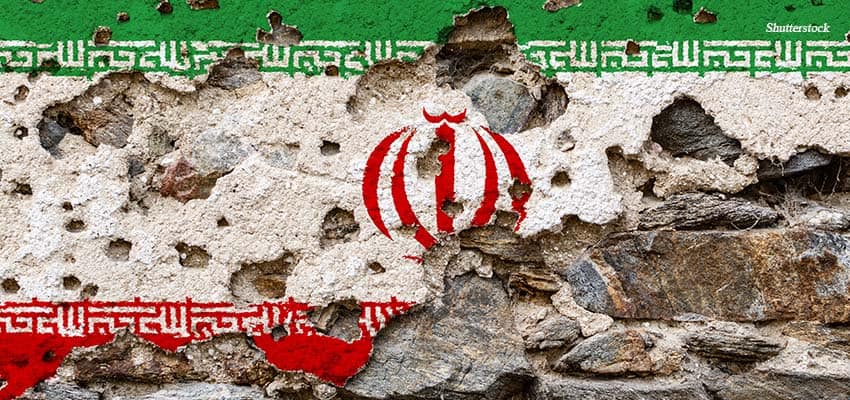
Just as this issue of WATCH magazine prepares to go to print, we find ourselves at war with Iran! The United States and Israel launched a joint bombing campaign that has devastated Iran’s leadership. The Ayatollah Khamenei is dead! Iranian President Masoud Pezeshkian is reportedly still alive at this writing. He is considered a moderate inside the regime though that may be relative to the radical pronouncements we have become accustomed to hearing out of Iran.
Pressure has been building on the Islamic Republic for a long time. Its proxies all over the region have been devastated. It was humiliated in last year’s spat with Israel and the US, retaliation was largely symbolic. Facing massive protests, the regime engaged in a brutal crackdown that they admit left thousands dead, with casualty claims by rights groups reaching as high as 30,000. The country imposed a total communications blackout during these actions to stop its opponents from coordinating and prevent the outside world from looking in.
The US steadily built up its forces in the region. Various negotiations yielded no progress. Iran refused to engage about its ballistic missile program, its support for terror proxy groups or address how it has treated its own people. Despite rosy characterizations of serious discussions, it was fairly clear that an impasse had been reached.
The issue is no longer in doubt. While many are decrying “unilateral action,” there is little debate about the Iranian regime being a source of evil both at home and abroad. Even Macron of France, while lamenting that the action was not referred to the UN, insisted that current leadership had disqualified itself from having any role in the future of the country.
What that future is remains to be seen. President Trump has encouraged the people of Iran to rise up and take control of their government after the bombing campaign is over. There is no indication how long it might last at this point.
Statements from people on the ground vary. Naturally, some are fearful. Others are ecstatic, thrilled to see an end to nearly 50 years of brutality and repression. Expatriates around the world have been out in the streets celebrating.
The bombing is still currently in full swing. Israel and the United States hit nearly 1,000 targets in the first hours of conflict. Even with its leadership crippled, Iran has managed to strike back. US military bases all over the region have been targeted. Saudi Arabia, the UAE, Bahrain, Qatar, Kuwait and Jordan have all faced attacks against bases in their territory, angering their governments. A friendly fire incident saw US fighters accidentally downed by Kuwait, though the pilots were able to escape.
So far, 4 US service members have been killed. The Chairman of the Joint Chiefs of Staff spoke today, indicating it would likely take some time for all of their current military objectives to be met and that more casualties are to be expected. Sadly, a number of Israeli civilians have been killed as well. The leadership of Iran knows it is in a fight for its survival and seems determined to inflict as much damage as possible on the way out. Hezbollah and the Houthis have been expected to join the fray. Israel has already moved against Hezbollah, striking cells throughout Lebanon.
The real question is what comes next? What kind of government is going to emerge once the dust settles? However it develops, it is going to be a massive change in Middle Eastern affairs. Iran has been a regional powerhouse, the primary counterweight to Saudi Arabia.
Additionally, they are the only nation dominated by Shia Islam. The majority of the Muslim world is Sunni, though Iraq has a significant Shia population and there are large minorities in other places such as Pakistan and Lebanon. The split between Shia and Sunni practitioners dates back to a dispute in the succession of leaders following Mohammad.
The divide is often bitter. Sometimes when you read of terrorist attacks, Mosques being hit by suicide bombers, it is due to this difference in practice. Pakistan and Afghanistan are also currently at war over attacks such as this and accusations that the Taliban allows terrorists to operate with impunity, striking into Pakistan and retreating.
Without a theocratic Iran there will be no major Shia power. Iran has bolstered its image in the Islamic world by being the most outspoken against the US and Israel. As we all know, they have committed serious time and resources to recruiting, training and supplying proxy groups. It has propaganda value by portraying them as on the front lines of the conflict with the West. Whatever transpires with the future government of Iran, it is unlikely that this will be allowed to continue.
Some have spoken of Iran as a potential “King of the South” that is prophesied to be a factor in world affairs at the end time. You can see this in chapters 10, 11 and 12 of the book of Daniel. There are historical fulfillments for much of what is mentioned, but this does not negate a future occurance. Many prophecies are dual. This one particularly gives the time frame for its ultimate fulfillment, “Now I am come to make thee understand what shall befall thy people in the latter days: for yet the vision is for many days” (Dan. 10:14). As with the Abomination of Desolation, which Daniel spoke of and Christ referenced as a sign of the end, Antiochus’ desecration of the temple almost 200 years before Christ did not negate the end-time recurrence He spoke of.
Iran is not the King of the South and given the current circumstances I doubt there are many who would make that claim today. The problem is territory though. We look for the resurrection of Rome and the “ten kings” that “shall make war with the Lamb” among the peoples and nations that Rome controlled (Rev. 17:12-14). Where else would you look? It is clear from Daniel 2 that it is a continuation of that same system that persists to the very end.
The same logic applies to the King of the South. Historically it was centered in Egypt. Daniel 11:42-43 mentions Egypt, Libya and Ethiopia. Iran has been a factor in the region but not to the extent of some of the Gulf kingdoms. They have supplied Sudan, which is between Egypt and Ethiopia, with drones and other armaments during their bloody and unresolved civil war.
Those days are over however. The single greatest change from the fall of Iran will be the loss of their influence. Without the religious, regional rivalry Iran represented, we could see a great many changes in the Middle East. Many of the other powers have their own contentions but Iran was a major impediment to even nominal unity in the region. Without them in the mix, there is going to be a major re-calibration of priorities.
It is worth noting that Egypt is largely kept afloat by foreign investment and aid from the Gulf Kingdoms. Libya has been split into two competing governments ever since the fall of Qaddafi. Sudan’s civil war has drug on for years. Ethiopia is not exactly stable but is not in the same state of open conflict as some of its neighbors. Without Iran sapping time and resources, attention could turn towards these regions.
Prophecy indicates enough unity to act against their northern rival. “And at the time of the end shall the king of the south push at him: and the king of the north shall come against him like a whirlwind, with chariots, and with horsemen, and with many ships; and he shall enter into the countries, and shall overflow and pass over” (Daniel 11:40). There is no unity today. Whether these nations are truly united or if they are more a confederation acting in concert like their northern rival, we will have to wait and see.
At some point the region is going to change and the fall of Iran is a step along the way. It is one of the most important developments in years. We certainly pray for the future of Iran as well as the safety and prosperity of the citizens who wish to live in peace. After all, they are the first and primary victims of the Ayatollahs. It is a momentous occurrence. The scenes of celebration from many of those who have fled over the years say a lot. One photo was of an elderly man, crying. You can imagine those who got out during the 1979 revolution, watching that regime develop from afar and knowing the kind of brutality, degradation and oppression that was being imposed on your friends, neighbors or even family. Hopefully the coming years will be better than the last decades. Whatever happens, we will be watching!