The story of this Quarter has been a tumultuous rise in tensions among the world’s leading powers. The United States has been rushing to reassert its geopolitical dominance. Allies and enemies alike have been re-calibrating their relationships in light of potential benefits and liabilities. Trade relationships have been completely reset. Deals and tariffs have been held up as the proverbial carrot and stick. There is an overriding sense that lines are being drawn for future conflicts, whether economic or military remains to be seen.
To say that Donald Trump hit the ground running for his second term would be a wild understatement. His administration has pursued its agenda like an all-out blitz. One might reasonably ask, why? Why the overwhelming sense of urgency in both foreign and domestic affairs?
Consider the big picture. This country has long been on a slow slide down. Our debt burgeoning, unchecked by congress and successive administrations without the will or political capital to actually do anything about it. Our economy tepid and at risk of being reliant on foreign adversaries for essential goods and materials. Our institutions grossly inefficient, shackled by red tape and pusillanimous pronoun protocols. Is the situation not urgent? Does it not deserve and require bold, decisive action?
Our reputation abroad has fared little better. Humiliation in Afghanistan; China trampling on its guarantees to Hong Kong, making aggressive demonstrations around Taiwan and its other territorial claims in the South China Sea; Russia undeterred in Ukraine, with North Korea providing troops and weapons to back them up; Iran actively supplying its terrorist proxies like the Houthis, who virtually stopped shipping through the Red Sea for a time. On the part of our allies, complacency to say the least, with a definite trend towards opportunism. Taken all together, this combination of factors gave the impression that the US was not the “force to be reckoned with” that it once was.
Needless to say, a great deal of that attitude has been put on notice. Economic and military might are the primary sources of American influence. On trade, traditional allies have been the first to fall in line. Britain, the EU, South Korea and Japan have been quick to reach agreements. This is worth noting because of the out-sized role the US plays in their economies as well as their defense planning.
Nor are inherent weaknesses to be overlooked. Japan has been the test case for debt to GDP ratios. Britain’s Labor government is already deeply unpopular and its economy, like most of Europe’s, could hardly withstand a major shock. Consider France, with a new Prime Minister (its fifth in 2 years) and the cry of “bloquons tout” (“block everything”) protests resounding at fever pitch over the idea that ANY significant budget cuts might take place. Nevertheless, they were among the most outspoken EU nations against reaching a trade rapprochement with the US.
While not exactly popular, tariffs have already had a startling effect on US finances. A $27 Billion budget surplus was reported in June. The country topped $100 Billion in revenue in a fiscal year for the first time and the Treasury Secretary projects it could grow to $300 Billion in the year to come. This was credited by Standard and Poor’s as the reason our credit rating held steady in August. Coupled with budget cuts, increased economic growth, and lower interest rates, the US might actually be able to do something about our excessive debt, which topped 124% of GDP in 2024.
In Asia, our allies fully realized their dependence on exports and their proximity to an ever more assertive China, resulting in a swift acquiescence to US trade stipulations. This highlights the fragility of many Western allied nations. Just as NATO members have largely bent to US demands, they lack credible alternatives. While many NATO countries have made sweeping statements about mutual defense and their commitments to increase military spending, what they have actually been able to commit to is far less impressive.
Italy has claimed it needs 10 years to actually reach its spending targets. It will only reach the old target of 2% in 2025 by counting certain domestic emergency services as “defense.” They are not the only country using this method to help them reach their goals. France, as referenced above, has spent the last year in virtual paralysis over its budget, making real increases impossible despite Macron’s bold rhetoric. Germany has made constitutional amendments to try and meet their targets and speed up the actual procurement process. Some of the political maneuvering to achieve this has not gone over well with the population however. Chancellor Merz’s handling of foreign policy in general has led the AfD to top some popularity polls for the first time, though the next scheduled election is years away.
Those that actually share borders with Russia have been far more committed and outspoken. The Baltic states all spend over 3% of GDP and Finland will reach that level in a few years. Finland has also taken steps such as closing and securing its 830 mile long border with Russia, as well as pulling out of a treaty that prohibited the use of landmines.
Poland already spends well over 4%, it shares a border with the small Russian possession of Kaliningrad and a much longer one with Russian ally Belarus. This has recently been closed due to a number of Russian drones crossing into Poland in an attack on Ukraine. Many observers believe it was an intentional probe of NATO’s readiness. Troops have also been moved to the border and their airspace closed as Russia and Belarus begin a joint military training exercise called “Zapad,” which means west. Earlier this year Polish, Lithuanian, US, and Portuguese troops simulated defending the Suwalki Gap, a critical stretch of the Polish-Lithuanian border. The Zapad exercises will also simulate taking this area.
All of this illustrates that, at least for the present, there is no alternative to US economic and military clout. That may change over time, but would require a monumental effort on the part of countries who are themselves largely out of order and prone to division. Though as one commentator put it, “why should 500 million Europeans ask 300 million Americans to defend them from 100 million Russians?” All those figures are somewhat off but they are close enough to show the potential for Europe to get fed up with the status quo.
Southeast Asian countries face a similar dilemma as China becomes more assertive. South Korea, the Philippines, and Japan particularly rely on US commitments as a counterweight and deterrent. We rely upon them to help contain China and protect our interests in the region, such as freedom of navigation. Geographically, they also “encircle” the Chinese coastline and host US military bases crucial to logistics in any real conflict.
However, the number and far-flung nature of our many commitments is both an asset and a liability. It fosters cooperation, leading to economic benefits and technological advancement, but these have their limits. We reach a situation where our resources cannot be stretched to meet every contingency at once. The collapse of the Soviet Union led to a brief period where the US was truly the world’s only superpower. Complacency abounded, leading allies to take military protection for granted at little or no cost to themselves. Not so today.
All are having to come to grips with reality. While China is not the USSR, it has carefully positioned itself as the leader of a potential alternative to the current Western-backed world order.
This was on full display at the recent meeting of the Shanghai Cooperation Organization in China. Formed to help demarcate post-Soviet borders, the SCO is now used to facilitate business and is a virtual “who’s who” of countries at odds with the West.
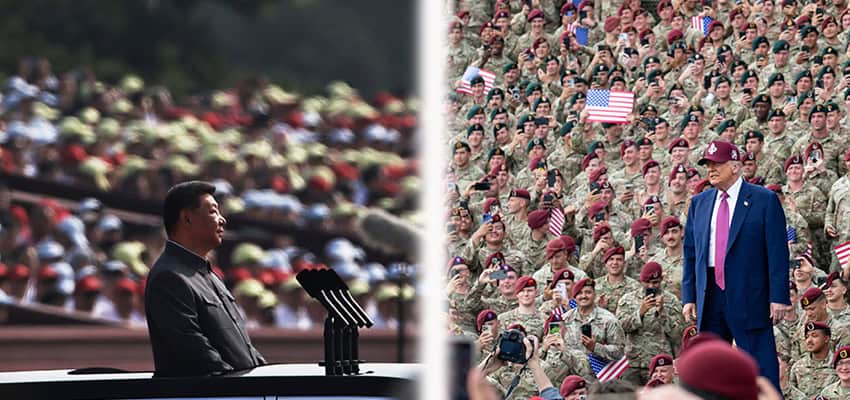
The leaders of China, Russia, Iran, India, and many others glad handed and spewed a series of platitudes. President Xi’s speech promoted “peaceful coexistence,” “the international rule of law,” and “the building of a more just and reasonable global governance system”. That’s pretty rich, considering he was flanked by Putin and Kim Jong Un at a massive military parade the following day.
But the ambiguous nature of many of these statements actually smooths over a good many differences between the participants. They are not hard commitments. They do not require any member to cut ties with the West, facilitating the participation of leaders with a leg in each camp such as Erdogan and Modi. The whole event does foster the belief that an alternative is possible. Insulating their economies and bypassing the Dollar are openly discussed, of particular importance to members facing sanctions and steep tariffs. The US knows that any real shift towards this is a serious economic threat and many recent actions have been aimed at deterring it.
Behind it all, China quietly extends its power and influence. Russia, while reasserting itself in Eastern Europe, is virtually dependent on Chinese support and supplies. North Korea depends on both for trade and legitimacy. Iran is also in desperate need of allies and a market for its oil.
India, on the other hand, needed to signal that it has options. In negotiations on trade with the US, India balked at several demands and talks eventually broke down. Agriculture is a protected sector and a multitude of small farmers make up a significant voting bloc. Opening that sector up to competition from US farmers was a major sticking point. India also refused to stop buying Russian oil, leading to a 50% tariff being levied on goods headed to the US. After a couple weeks of stalemate there are now signs of a thaw. Both Modi and Trump now speak positively of plans to resume negotiations. Indian interests are complex as they have had deep ties to the West and a long relationship with Russia, conflict with China and open hostility with Pakistan just this year.
Meanwhile, China has been increasing its influence in other spheres. Brazil, under Lula’s leftist leadership, has turned increasingly eastward. It has absorbed 50% of US tariffs primarily thanks to Chinese markets. This has worked out well for China also, who currently maintains an uneasy trade truce with the US. China has replaced many of its agricultural imports from the US with Brazilian products. Soy and beef volumes have seen enormous growth. China has solidified its role in South American economies by investing heavily in infrastructure, the necessary roads, trains and ports to get the products and raw materials it needs to market.
Meanwhile, the United States has virtually blockaded Venezuela, with warships off both the Caribbean and Pacific Coasts. Our administration now refers to Maduro as the leader of a narcotics cartel, a clear signal that he could be in the cross-hairs soon. As if the $50 Million bounty wasn’t clear enough. Can this be viewed as a separate issue, when China and Russia have been Venezuela’s primary supporters?
In many ways the gauntlet has been thrown down and the challenge has been accepted. The US is not sitting idly by, on a slow slide to nowhere good, while enemies and allies alike take what advantage they can. Nor have those in opposition yet blinked.
War rages on in Ukraine, with each side reliant on the support and munitions of its benefactors. Economic pressure has about reached its maximum, verging on peril for those yielding it. Many in key states such as Germany and India are already uncomfortable with what has been asked or required of them, preferring to play both sides for their own economic benefit. Will we slide towards war? Will there be an uneasy peace that accelerates the trends already at work? Will dependency rankle many nations and lead them to reassert themselves both economically and militarily?
At some point all of this will lead to the apocalyptic events of Bible prophecy and the domination of the world by major power blocs. We do not claim the sky is falling but neither do we say, “my Lord delays His coming.” It is hard not to view the path from the present to the end in the fewest possible steps. It takes prudence and faith to wait on the Lord and His timing. Our job is to WATCH patiently and carefully, awake and ever-ready, putting our gifts and talents to the best possible use as our Lord did. “Redeeming the time, because the days are evil” (Ephesians 5:16).
“Blessed is that servant whom his Master will find so doing when He comes” (Luke 12:43 ESV).