America the Beautiful, America the BLESSED
As the United States marks its semi-quincentennial in 2026, 250 years after the Declaration of Independence, it is fitting to reflect on the nation’s profound origins – not merely in the annals of colonial history, but in the ancient prophecies of Scripture. Amid the fireworks and parades, a deeper meaning emerges from the pages of the Bible and historical records: the idea that Anglo-Americans are the modern descendants of the Biblical tribe of Manasseh, one of the “lost” tribes of Israel. This theory, known as British-Israelism or Anglo-Israelism, posits that the promises given to the patriarchs Abraham, Isaac, and Jacob have been fulfilled in the rise of the British Empire and the United States. Far from a fringe notion, it draws on centuries-old materials, including works like John Harden Allen’s Judah’s Sceptre and Joseph’s Birthright (1902), and continues to resonate among many. In this article, we delve into the Biblical, historical, and prophetic evidence supporting this identification.
The framers of the U.S. Constitution, as evidenced by their writings and debates, believed they were crafting a groundbreaking framework for government that could foster an enduring republic capable of promoting liberty, justice, and prosperity. They viewed this effort as essential for building a “great nation” that might serve as an example for the world –– as a light to the nations.
America –– the Bulwark of Western Civilisation
An example of this would be Secretary of State, Marco Rubio, at the Munich Security Conference 14 February 2026, who clearly presented the American position as world leader:
“…We increasingly outsourced our sovereignty to international institutions while many nations invested in massive welfare states at the cost of maintaining the ability to defend themselves. This, even as other countries have invested in the most rapid military build-up in all of human history and have not hesitated to use hard power to pursue their own interests. To appease a climate cult, we have imposed energy policies on ourselves that are impoverishing our people, even as our competitors exploit oil and coal and natural gas and anything else –– not just to power their economies, but to use as leverage against our own.
“And in a pursuit of a world without borders, we opened our doors to an unprecedented wave of mass migration that threatens the cohesion of our societies, the continuity of our culture, and the future of our people. We made these mistakes together, and now, together, we owe it to our people to face those facts and to move forward, to rebuild …
“And finally, we can no longer place the so-called global order above the vital interests of our people and our nations. We do not need to abandon the system of international cooperation we authored, and we don’t need to dismantle the global institutions of the old order that together we built.
“But these must be reformed. These must be rebuilt.”
Rubio is one in a long line of politicians and influencers who can see that America and the West’s civilisation and culture is being undermined and trashed. And that it is therefore up to America to defend it as most other Western nations refuse to, or even encourage their own decline.
How can America undertake such an immense task?
America: the Shining City on the Hill
Many commentators, politicians and religious leaders are astounded by the uniqueness of the United States of America. Its blessings and greatness.
How can this be? Was America (like the British Empire) a blessing from God Almighty? So impressed are they with all that makes America, they use the term Manifest Destiny or Exceptionalism to describe how America must have been Divinely ordained to expand across North America, spreading democracy, civilisation, and prosperity. And to be a light to the world.
Puritan leaders and other early American clergy, including John Winthrop, Cotton Mather, Jonathan Edwards, and Ezra Stiles, often depicted America as a “city upon a hill” or similar phrase (from Matthew 5:14, which resonated with Isaiah’s Zion) and a land with a unique Divine purpose.
Many leaders of the United States have noted that it is the Great God Who has showered upon America tremendous blessings, for which many seem neither grateful nor deserving. For instance, from a Proclamation issued 30 March 1863 for a national day of fasting and prayer President Lincoln wrote:
“We have been recipients of the choicest bounties of Heaven. We have been preserved, these many years, in peace and prosperity. We have grown in numbers, wealth, and power as no other nation has ever grown; but we have forgotten God. We have forgotten the gracious hand which preserves us in peace, and multiplied and enriched and strengthened us; and we have vainly imagined, in the deceitfulness of our hearts, that all these blessings were produced by some superior wisdom and virtue of our own.”
Another is from President Dwight Eisenhower in 1954. It reflects his views on the role of Biblical principles in American identity and governance:
“The purpose of a devout and united people was set forth in the pages of the Bible… (1) to live in freedom (2) to work in a prosperous land … and (3) to obey the commandment of God…. This Biblical story of the Promised land inspired the founders of America. It continues to inspire us.”
This statement draws a parallel between the Biblical Exodus –– the Israelites’ journey to the Promised Land as a place of freedom and prosperity under God’s guidance –– and the vision that motivated early American settlers and Founders (e.g., the Puritans’ “city upon a hill” imagery or references to a new Canaan in colonial writings).
Later that year he added “under God” to the Pledge of Allegiance.
Twenty years later, on 25 January 1974, Ronald Reagan spoke at the first Conservative Political Action Conference (CPAC) where he referred to America as “a shining city upon a hill,” drawing from Puritan leader John Winthrop’s 1630 “city upon a hill” sermon but adding “shining” to the statement.
He used the term again over the years in 1976, 1979, 1980, 1989.
Decades prior, Winston Churchill during his address to the US Congress on 26 December 1941, made the following significant proclamation:
“I will say that he must indeed have a blind soul who cannot see that some great purpose and design is being worked out here below of which we have the honor to be the faithful servants,”
He also wrote and spoke extensively about the “English-speaking peoples” (including Britain, the US, Canada, Australia, etc.) as bearers of liberty, law, and parliamentary institutions. In his multi-volume work A History of the English-Speaking Peoples (published 1956–1958), he presented their story as the growth of freedom. His rhetoric consistently elevated the British as a people with a peculiar historical role, and mission.
Roots in Ancient Israel
It is almost uncanny that so many political and religious leaders could understand how special –– exceptional –– the Anglo-Kelts have been on the world scene. On occasion they drew parallels with ancient Israel, leading to one wondering if they had a deeper perception to what they let on. Or at least there was a gradual awakening to the destiny of these peoples which appeared to have Biblical roots. The parallels are too powerful to ignore.
The foundation of this identity traces back to Genesis, where God covenants with Abraham: “I will make of thee a great nation… and in thee shall all families of the earth be blessed” (Genesis 12:2-3). This promise expands to include a multitude of descendants as numerous as the stars or dust of the earth, possession of enemies’ gates, invincibility in battle, and vast territorial blessings (Genesis 22:17-18). These covenants pass to Isaac and then Jacob (renamed Israel), whose twelve sons form the tribes of Israel.
Importantly, Jacob bestowed the birthright upon Joseph, his favored son, rather than the firstborn Reuben, due to Reuben’s transgression (1 Chronicles 5:1-2). Joseph’s sons, Ephraim and Manasseh, are adopted as Jacob’s own, elevating them to tribal status (Genesis 48:5). In a prophetic blessing, Jacob declares: “Let them grow into a multitude in the midst of the earth… Manasseh shall become a people, and he also shall be great: but truly his younger brother [Ephraim] shall be greater than he, and his seed shall become a multitude of nations” (Genesis 48:16-19). Here, Manasseh is foretold as a single “great people,” while Ephraim becomes a “multitude of nations.”
These promises are distinct from the “sceptre” given to Judah: “The sceptre shall not depart from Judah… until Shiloh come” (Genesis 49:10), interpreted as the royal line leading to the Messiah. Thus, the birthright (national blessings) goes to Joseph, while the sceptre (kingship) remains with Judah.
After Solomon’s reign, the united kingdom of Israel split: the southern Kingdom of Judah (which included the tribes of Judah, Benjamin, and part of Levi) remained loyal to David’s house, while the northern Kingdom of Israel (ten tribes, including Ephraim and Manasseh) rebels under Jeroboam (1 Kings 12). The northern kingdom, often called “Israel” or “Ephraim” in prophecy, turns to idolatry and is exiled by Assyria around 721 BC to regions such as Halah, Habor, and the cities of the Medes (2 Kings 17:6).
Post-exile, these tribes vanish from mainstream history, becoming the “lost ten tribes.” Yet, prophecies foretell their scattering and eventual restoration: “I will sift the house of Israel among all nations… yet shall not the least grain fall upon the earth” (Amos 9:9). Hosea 1:10 promises they will become “sons of the living God” in distant isles, losing their identity but inheriting blessings after a 2,520-year punishment (seven prophetic “times” from Leviticus 26). British-Israelism asserts these tribes migrated northwest through the Caucasus (as Cimmerians and Scythians), into Europe, and eventually the British Isles and Scandinavia, partially fulfilling Isaiah 49:12: “Behold, these shall come from far: and, lo, these from the north and from the west.”
Movement from Britain and Europe
On 10 April 1606, King James I of England issued a charter for the Virginia Company to claim land for England, to conduct trade, and to return a profit. In 1620, the Pilgrims arrived on the Mayflower and established the Plymouth Colony in Massachusetts.
In 1616, English explorer John Smith named the region “New England”. The name was officially sanctioned on 3 November 1620. The region consists of six states: Connecticut, Maine, Massachusetts, New Hampshire, Rhode Island, and Vermont.
Perhaps New England can be considered a “new land of the Angles” in a symbolic, cultural, and to some extent, genealogical sense.
Why? Because many of the earliest British migrants to colonial America in the 1600s came from eastern and midland regions of England. This included the Pilgrims, who primarily originated from an arc of villages in Nottinghamshire, Lincolnshire, and southern Yorkshire in the north and east Midlands. The much larger Puritan migration (around 1630–1640) drew heavily from East Anglia and adjacent counties, including Norfolk, Suffolk, Essex, and Kent. Smaller early groups, such as those settling Jamestown in 1607, often came from southern and western England (e.g., Gloucestershire, Somerset, Devon, and Hampshire), but the dominant early waves to New England were from the eastern regions.
These areas broadly overlap with regions historically settled by the Angles during the Anglo-Saxon migrations in the 5th-6th centuries. The Angles established kingdoms in East Anglia (hence the name), Mercia (covering much of the Midlands, including Nottinghamshire and Lincolnshire), and Northumbria (including Yorkshire). While not all early migrant origins were exclusively from Angle-settled territories –– some southern English areas were more Saxon-influenced –– the majority apparently originate with these regions.
US Ethnic Composition
The dominant European population in the US was overwhelmingly from British stock from the earliest times.
Research indicates the following European ethnic percentages among Americans since the 1700s to modern day:
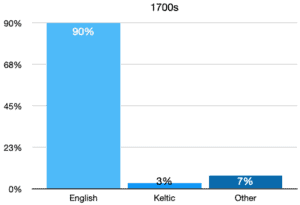
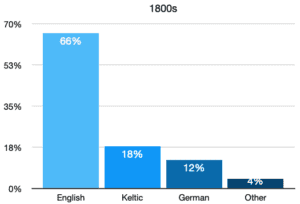
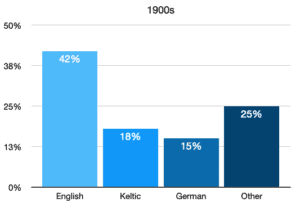
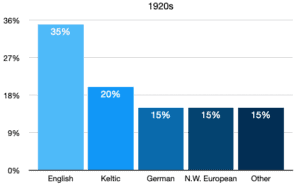
Here are approximate percentages for those Americans claiming descent from northern and northwestern European stock based on 1920-era data:
Based on the latest U.S. Census Bureau data from the 2022 American Community Survey, here are the current approximate percentages :
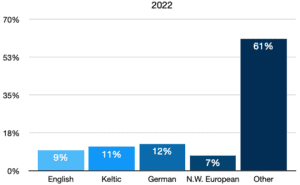
These figures are based on a U.S. population of approximately 333 million.
NB: Tens of thousands of Scots migrated to Scandinavia, France, Holland, Germany and the Baltic states during the period of mid-17th century into the mid-18th century. Around 30,000 migrated to Poland-Lithuania during that period mostly as merchants, peddlers, and tradespeople, though some were involved in military roles too. Perhaps many migrants to the U.S. from these areas were actually descendants of Scots?
Concerning the German element, many or most German immigrants to the U.S. since the 1800s originated from west-central and southwestern regions of what is now Germany, particularly areas such as the Rhineland-Palatinate, Hesse, Baden-Württemberg, and parts of Westphalia and Thuringia. This includes the far west near the borders with France and Belgium (e.g., the Palatinate region and Rhineland), which was a major migrant source due to economic pressures, religious conflicts, and overpopulation in the 18th-19th centuries. The Germans from this region were rather different from the Prussian and Bavarian elements. Those arriving in the post-German unification period wave (after 1871) were not impressed with Otto von Bismarck’s increasingly militaristic approach – due to his unified German Empire as a place of economic hardship, political repression, and mandatory military service. The migration of the 1880s decade saw 1.5 million “German” migrants to America alone.
Over time, the Anglo-Keltic element has decreased markedly as a percentage of population, yet its influence over the national character remains. It has imprinted itself onto the national psyche, which, while their overall numbers are diminishing, still dominates.
Of interest, President Trump’s own mother hailed from the village of Tong on the Isle of Lewis in Scotland and his grandparents on his father’s side came from Kallstadt in Germany, only 50–60 kilometers (about 30–40 miles) northeast of the nearest French border point. His behavioural patterns, fortitude, brashness and cavalier spirit indicates that the Keltic side clearly dominates!
Gradual Awakening to American Origins
We have seen how the early Pilgrims and numerous early American religious figures established clear connections between America and ancient Israel or Zion, perceiving the New World as a Divinely ordained land for a chosen people fleeing persecution. This viewpoint was deeply embedded in Puritan theology and Biblical understanding which impacted hundreds of place names across America (e.g., Salem, Bethel, Zion) and bolstered a sense of Manifest Destiny linked to the Bible.
Early religious leaders drew inspiration from Old Testament principles to advocate for moral governance, integrating aspects of Mosaic law into colonial law and sermons.
During the Revolutionary period, individuals such as Samuel Langdon explicitly referenced the “Republic of the Israelites” as a model for the new American states, highlighting similarities in covenants, leadership, and resistance to oppression. This Hebraic influence also manifested in proposals for national symbols, with Benjamin Franklin and Thomas Jefferson suggesting seals that illustrated the Israelites’ exodus or wilderness journey. These leaders portrayed America as a spiritual heir to ancient Israel. Little did they know at that time that Anglo-Kelt Americans were the direct descendants of ancient Israel!
The parallels were too uncanny to ignore. One wonders if they were alive in the late 19th century and had witnessed the American miracle whether they would have taken this view a step further and come to the realisation of America’s true Biblical identity and destiny.
America as Manasseh
Is it possible that the Anglo-Saxon elements in America represents one portion of the tribe of Manasseh while many of those particular Germans from the far western part of Germany represent another portion? When these departed Germany they left behind the Assyrian peoples to fill the void. If so, this may reflect the setup in ancient Israel which found Manasseh in two divisions: one part lived in Gilead south-east of the River Jordan while the other part settled west of the Jordan River. This split made Manasseh the only tribe with significant territory on both sides of the Jordan, creating two semi-independent sections that sometimes had separate leadership (e.g., 1 Chronicles 27:20-21).
During the fifth and sixth centuries AD, the Angles and the Saxons traversed the English Channel after residing for a period in far north-western Germany and southern Denmark (leaving behind their kin a little further south, in the far west of Germany nearer the French and Belgian borders). The Angles established themselves in the eastern counties of Anglia, including Norfolk and Suffolk, as well as in the Lothian areas of south-east Scotland. Meanwhile, the Saxons occupied most of the remainder of England, displacing many indigenous Keltic Britons further to the west.
As we have seen, a large proportion of individuals who emigrated to America from England originated from the eastern regions of England (for instance, the Anglian counties) where the Angles had settled.
It appears therefore, that it was the, it was the Angles (rather than the Saxons), whose descendants constitute a significant portion of America’s Anglo population, who lent their name to England, which translates to “Angle-land.” The term Angle is possibly derived from the Hebrew word “Egla,” which primarily signifies a heifer (Hosea 10:11), a bull and a wild ox (mistranslated as a unicorn in the King James Version).
“His glory is like the firstling of his bullock, and his horns are like the horns of unicorns: with them he shall push the people together to the ends of the earth: and they are the ten thousands of Ephraim, and they are the thousands of Manasseh” (Deuteronomy 33:17).
“And the remnant of Jacob shall be among the Gentiles in the midst of many people as a lion among the beasts of the forest, as a young lion among the flocks of sheep: who, if he go through, both treadeth down, and teareth in pieces, and none can deliver” (Micah 5:8).
This awesome power and world dominance has been bestowed upon the end-time descendants of Ephraim and Manasseh as a force for good in the world.
As part of this awakening to their origins and destiny, Biblical scholars, during the latter nineteenth century, began to understand that the Anglo-Saxons and Kelts descended directly from ancient Israel.
For example, Our Israelitish Origin by John Wilson (1840) which became one of the foundational texts for arguing that Anglo-Saxons (including those in America) descend from the “lost” tribes of Israel, including implications for Manasseh in the U.S.
Forty-Seven Identifications of the Anglo-Saxons with the Lost Ten Tribes of Israel by Edward Hine (1878) identifies the Anglo-Saxons as the lost tribes, with the United States linked to Manasseh.
Another is the pamphlet Manasseh and The United States by Rev. Joseph Wild (1882) which argued that the United States fulfills prophecies related to the tribe of Manasseh.
Various prophecies such as those found in Amos 6:1 (Samaria) and Jeremiah 8:22 (Gilead) where the tribe of Manasseh dwelt in ancient times, may provide prophetic clues as to American’s end-time destiny
During the celebrations of America’s greatness and achievements this year, may the nation and other peoples glorify and thank God Who bestowed upon the country the enormous blessings of Manasseh.