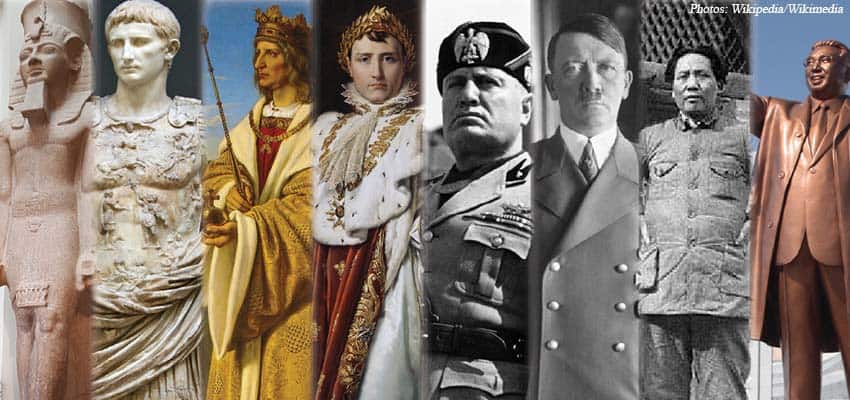
The Cult of Emperor Worship – Will It Return?
For thousands of years, mere mortal humans have claimed to be gods, a god in the flesh or revered as sort of gods.
These vile claims ranged from ancient Emperors who were identified as gods to modern sporting heroes and celebrities who are treated as such.
Of later incarnations of such evil, God’s Word warns us:
“Let no one deceive you in any way. For that day will not come, unless the rebellion comes first, and the man of lawlessness is revealed, the son of destruction, who opposes and exalts himself against every so-called god or object of worship, so that he takes his seat in the temple of God, proclaiming himself to be God.” (II Thess. 2:3-4, ESV).
“And they worshiped the dragon, for he had given his authority to the beast, and they worshiped the beast, saying, ‘Who is like the beast, and who can fight against it?’
“And the beast was given a mouth uttering haughty and blasphemous words, and it was allowed to exercise authority for forty-two months.
“It opened its mouth to utter blasphemies against God, blaspheming his name and his dwelling, that is, those who dwell in heaven.” (Rev. 13:4-6, ESV)
Whether a prophesied political or religious figure or a modern-day celebrity, there seems to be this vanity-led desire for excess honour and even literal worship as a god or even as God Himself. The blasphemy is incomprehensible.
The Ancient Origins of the Human Desire for Worship
It is almost as if there is something within human nature that seems to need to worship a higher and superior being. But alas, humans have been deceived to follow and worship the wrong “gods” –– humans. This has been happening since the early days of human existence on this planet.
Professor Henry Burton explains the ancient roots of emperor worship:
“The impulse that led to the deification of the Roman emperors came from the East. The Pharaohs and the Ptolemies, Lycurgus and Lysander of Sparta, and Alexander the Great were worshiped as divinities both while living and when dead. When Rome conquered the East, the same divine honors were transferred to the Roman proconsuls. Naturally, then, when a single ruler of the empire appeared, he was acclaimed as a god in the eastern provinces. Meanwhile the way had been prepared for the imperial worship in the minds of the Romans themselves. The heroes of Roman legend, as Aeneas, Latinus, Romulus, whom the Romans accepted as historical personages and as the founders of the nation, were believed to be of divine descent and were themselves honored as deities. It was natural, therefore, that the founder of the empire, a new and greater Rome, should likewise be regarded as a god and be accorded the same homage. Another precursor of the imperial cult was the worship of the Dea Roma. This divinity, the personification of the growing power of Rome in the East, was a Greek invention. Temples were first erected to her in the second century B.C. in Asia Minor, her cult became associated with that of the emperor both in the East and in the West during the reign of Augustus and finally received full recognition at the capital through the building of Hadrian’s great temple of Venus and Roma.” (“The Worship of the Roman Emperors,” Biblical World, August 1912, p. 80)
Caligula (37-41 BC) demanded to be worshipped as a living god; having failed to establish military credibility and concerned for his safety, he chose to proclaim his divinity. He also intended to relocate to Alexandria in Egypt, where he could present himself as a living god, beyond the legal reach of the Senate. He constructed temples in his honor but was not granted posthumous deification due to the Senate’s refusal.
The practice, commonly referred to as the Imperial Cult, involves the veneration of Emperors and certain members of their families as divine figures. They carried the divinely endorsed authority of the Roman state. This tradition commenced following the death of Julius Caesar in 44 BC, when the Roman state officially recognized him as “divus,” or divine. This system drew upon both Roman and Greek traditions and was established during the early Principate of Augustus. The cult of worship played a significant role in fostering unity across the expansive empire.
Nero (54-68 AD) garnered a cult following in the East and was promoted as divine, yet he was not deified (condemned by the Senate after his demise). Domitian (81-96 AD) insisted on being addressed as Dominus et Deus (i.e., Lord and God). Commodus (180-192 AD) identified himself as Hercules and was permitted worship.
Other emperors received posthumous deification after their deaths.
Initially, Roman Emperors demanded worship and persecuted both the true and the false churches to eliminate rivals:
“As the emperor cult developed, it became ever more clearly a form of Antichrist, as Christians were commanded to substitute the words kyrios kaiser (‘Caesar is Lord’) for their basic Christian confession kyrios Jesus (‘Jesus is Lord’), Augustus had been the first emperor to claim divinity and solicit worship … But it was Domitian, who became emperor in 81 AD and demanded to be worshipped as Dominus et Deus, who persecuted those who denied him the divine homage he coveted.” (John Stott, The Message of Thessalonians. The Bible Speaks Today, (1961) p. 161).
Middle Ages
The Holy Roman Emperor, despite the title “Holy,” could not be considered a deity as he was inherently Christian. Furthermore, while the doctrine explicitly prohibited the veneration of the Emperor as a god, this also served as a benefit to the Emperors because it stated:
1. Jesus had already manifested on Earth and possessed the sole legitimate divine claim. Now he resided in Heaven, where he rightfully belonged (and, by the way, could not cause disturbances by advocating for the impoverished).
2. Consequently, no one else could emerge to assert divine authority. This positioned the Pope and the Emperor as the “representatives” of the divine on Earth. However, the most advantageous aspect for them was that any future prophets would necessarily be deemed false prophets. Thus, the orthodoxy that upheld both the Pope and the Emperor could not be contested.
It is this representation that often led to their conflicts.
But it didn’t end there –– the continuing rivalry has been unabated ever since:
“Francis I, Louis XIV, Napoleon, saw themselves as the Holy Roman Empire’s legitimate heirs. Popes waged a thousand-year-long battle with emperors for the right to Rome.” (Friedrich Heer, The Holy Roman Empire, p. 1)
“The supremacy of ecclesiastical power must finally give way to the stronger sceptre of the secular monarch. Becket must yield to Henry. The struggle may be prolonged and disastrous” (Benjamin Newton, Progress Towards the Formation of the Ten Kingdoms (1873), p. 415). A future conflict after a brief ‘fling’ with the State will result in disaster for the Great Church.
Modern Worship and Glorification
It also seemed that Napoleon might have perceived himself as superior to the Pope. During his coronation ceremony on December 2, 1804, Napoleon denied the Pope the privilege of placing the imperial crown upon his head, opting instead to crown himself. Furthermore, he took it upon himself to crown his first wife, Josephine, as Empress, once again excluding the Pope from this act.
Napoleon sought to place the Pope under his dominion. The irony of the entire scenario should not be overlooked. The French Revolution had nearly eradicated Catholicism from the nation, primarily due to the radical transformations brought about by the Enlightenment. Many participants in the Enlightenment movement were either atheists or deists, indicating that God was not a significant influence in many of the advancements initiated by Enlightenment thinkers. Ironically, several years following Robespierre’s death (an ardent deist), Napoleon (who was also a deist), managed to restore the church that had been so harshly persecuted just a few years prior. Nevertheless, he twice imprisoned Popes.
More than a century later, Benito Mussolini was born to an atheist father and a devoutly Catholic mother. Although Mussolini was baptized as a Catholic, he renounced his faith in his youth, choosing instead to adopt his father’s beliefs. Over time, he developed a form of worship centered around the State. His fascist movement made the following statement:
“The Fascist State has never tried to create its own God, as at one moment Robespierre and the wildest extremists of the Convention tried to do; nor does it vainly seek to obliterate religion from the hearts of men as does Bolshevism: Fascism respects the God of the ascetics, of the saints, of the heroes, and also God as seen and prayed to by the simple and primitive heart of the people.” (La Dottrina del Fascismo [The Doctrine of Fascism], published in Enciclopedia Italiana, June 1932.)
Following his acquisition of power during the March on Rome in 1922, Mussolini strategically softened his atheistic stance to garner support from both the Catholic Church and Italian nationalists. He entered into the Lateran Treaty with the Vatican in 1929, which reinstated papal sovereignty and acknowledged Catholicism as the official religion of Italy. This represented a significant rhetorical shift, framing Fascism as being in harmony with faith, yet not subordinate to it, much like the German National Socialists.
Despite this, Mussolini remained an atheist throughout his life; however he expressed remorse and reverted to the Catholic faith of his youth days prior to his capture and execution –– probably due to pragmatism and fear, rather than genuine repentance. In 1957 his remains were returned to his family and were buried in a Catholic grave.
Hitler believed similarly. The Occult in National Socialism by Stephen Flowers is a must read in regard to all of this. British historian Richard J. Evans, who writes primarily on Nazi Germany and World War II, noted Hitler claiming that Nazism is founded on science: “Science, he declared, would easily destroy the last remaining vestiges of ‘superstition.’ Germany could not tolerate the intervention of foreign influences such as the Pope and ‘Priests’, he said, were ‘black bugs’, ‘abortions in black cassocks’” (Richard Evans, The Third Reich at War (2009), p. 547).
“As late as 1933, he still described himself publicly as a Catholic. Only the spreading poison of his lust for power and self idolatry finally crowded out the memories of childhood beliefs and in 1937 he jettisoned the last of his personal religious convictions, declaring to comrades, ‘Now I feel as fresh as a colt in the pasture’” (Max Domarus, The Essential Hitler: Speeches and Commentary (2007), p. 21).
The biographer John Toland recounts that following an attempted assassination in 1939, Hitler informed his dinner guests that Pope Pius XII would have preferred the “plot succeed” and “was no friend of mine.” However, he also notes that in 1941, Hitler remained “a member in good standing of the Church of Rome despite his detestation of its hierarchy” John Toland, Adolf Hitler: The Definitive Biography (1976), pp. 589, 703).
Nazi Propaganda Minister, Joseph Goebbels, played a pivotal role in constructing Adolf Hitler’s “Führer cult” or cult of personality, systematically elevating him to a god-like, messianic status through speeches, articles, broadcasts, and media campaigns. This portrayal depicted Hitler as an infallible saviour chosen by providence, a quasi-divine mediator between the German people and higher powers, and the embodiment of national destiny.
In 1935 Goebbels proclaimed: “He is flesh of its flesh and spirit of its spirit… He is now what he always was, and always will be: Our Hitler!” In 1936, he declared: “Germany has been transformed into a great house of God… where the Führer as our mediator stood before the throne of the Almighty.” And in 1945: “We feel him in us and around us. God give him strength and health and preserve him from every danger. May he remain what he is to us and always was — Our Hitler!”
Hitler did nothing to rebuke Goebbels and overturn these appalling god-like references.
The Fate of Those Who Claimed Divinity or Mocked Christ
Below is a curated list of historical and modern figures who either explicitly claimed to be God, Jesus Christ (or his reincarnation/second coming), or a messianic figure, or who made blasphemous statements elevating themselves to divine status (e.g., mocking or comparing themselves to God/Jesus). I’ve focused on those with notably strange, violent, or mysterious deaths.
John Nichols Thom (also known as Sir William Courtenay –– 1799 – 1838) claimed to be the reincarnation of Jesus Christ, the “Saviour of the World,” and invulnerable to bullets. He was killed by government soldiers during the Battle of Bossenden Wood.
Arnold Potter (also known as Potter Christ –– 1804 – 1872) was a religious leader who claimed the spirit of Jesus entered his body, making him the “Son of the living God.” Died attempting to “ascend into heaven” by jumping off a cliff in Marquette, Michigan; his body was later retrieved from Lake Superior and buried by followers who believed he would resurrect.
Edmund Creffield (also known as Joshua –– 1856-1906) Founder of the “Brides of Christ” cult who preached “free love” and claimed followers would birth the reincarnated Christ through ritual purification. Shot in the face on a Seattle street by George Mitchell, the brother of a former follower.
John Lennon (1940 – 1980) famously stated in 1966 that the Beatles were “more popular than Jesus,” which was seen by many as mocking or elevating the band to divine status, sparking global backlash including record burnings. He was assassinated outside his New York apartment by Mark David Chapman, an obsessed fan.
Krishna Venta (born Francis Pencovic –– 1911 – 1958) founded the Fountain of the World cult; claimed to be the reincarnated Jesus Christ who led rocket ships from the lost planet Neophrates to Earth. He was killed in a suicide bombing by two disgruntled ex-followers.
Adolf Hitler (1889 – 1945) cultivated a messianic image as Germany’s saviour, with propaganda portraying him as a divine or quasi-godlike figure; some followers viewed him as a Christ-like redeemer. Committed suicide by cyanide capsule and gunshot in his Berlin bunker as Soviet forces closed in during WWII’s final days; his body was partially burned by aides in a shell crater and remains were later desecrated and scattered to prevent a gravesite pilgrimage.
Benito Mussolini (1883 – 1945) Italian fascist dictator who styled himself as Il Duce (The Leader), with a cult of personality implying god-like infallibility; allied with Hitler in promoting authoritarian “salvation” narratives. Captured by Italian partisans, summarily executed by machine gun, and hung upside down from a meat hook in a Milan gas station alongside his mistress Clara Petacci; their bodies were stoned, spat on, and urinated upon by crowds in a public desecration.
Amy Carlson (also known as Mother God –– 1975 – 2021) was leader of the Love Has Won cult; claimed to be a 19-billion-year-old deity embodying Jesus, Mother Earth, Cleopatra, and others, with full memories of being crucified. Her mummified body was discovered wrapped in a sleeping bag adorned with Christmas lights and glitter in a Colorado trailer home after followers transported it across states believing she would resurrect; autopsy ruled death from alcohol abuse, anorexia, and drug ingestion.
This list highlights patterns of violent ends, failed ascensions, or cult-related fallout often tied to their claims. Many such figures attracted devoted (and dangerous) followings, contributing to the strangeness of their demises.
Be careful of what you wish for or who you claim to be. Do not pretend to be something you are not!
Attempted Assassination and Miracles?
If one looks at the historical record, it would appear that the system that has been so prominent for centuries has seen movements of morphing from a Holy Roman Empire into one that glorifies the emperor similar to the Roman Empire.
Consider Napoleon’s, Mussolini’s and Hitler’s initial Concordats with the Vatican. But Napoleon took two Popes into captivity and Hitler had definite plans to do the same (both of these men were deists).
Mussolini’s relationship with the Vatican was not always smooth. Read Peter Kent, “How Pius came to regret his deal with the duce: The Pope and Mussolini,” The Irish Times, 24 May 2014.
The future Beast will turn upon the Great False Church as the Beast will want to be worshipped in lieu. To be a sort of Roman Emperor (cp. Dan. 11:37; Rev. 13:4).
Something will happen to trigger this –– perhaps an attempted assassination (Rev. 13:3), similar to Hitler’s.
“Whether the death is real or faked (cf. v.14; 2 Thess. 2:9) is not clear … Antichrist’s alleged death and resurrection will be a counterfeit of Christ’s death and resurrection, staged, as one of the ‘lying wonders’ perpetrated by the false prophet (13:12-15; 2 Thess. 2:9 NKJV). Antichrist’s death will be phony since he never really died” (John MacArthur, Revelation 12-22. The MacArthur New Testament Commentary (2000), pp. 45-46).
As only God can resurrect (the Devil cannot), it is unlikely that he will be fully dead. Perhaps clinically dead in the sense of no heartbeat, etc., for a minute or two; or in a coma. In any event, he counterfeits Christ. This will lead to his worship and increased rivalry with the Great False Church. Many will see this as the coming of Christ (II Thess. 2:9 compared to verse 8) accompanied by amazing miracles and wonders that could even deceive the elect (Matt. 24:24).
“… when they see such a miracle wrought in the person of Antichrist –– namely, in his resurrection from the dead [probably a coma], and his speaking death-dealing effigy –– there will be no room left for further scepticism, and they will at once render Divine homage to the man of sin or lawless one … that man-worship, which will be one of the worst signs of the last times.
“… he will become supreme king of revived Rome. To this dignity he will be elevated by the ten kings of eastern and western Rome … thus electing Antichrist as Emperor … as in the case of his prototypes, the two Napoleons …” (Edward Hytche, “The Doom of the Antichrist”, The Prophetic News and Israel’s Watchman, June (1882), p. 173)
Consider precedents of the latter Roman Emperors being considered as gods as discussed above; Napoleon behaved god-like; Wilhelm II enacted Christ’s entry into Jerusalem on a Sabbath riding on a white horse; Goebbels called Hitler a god; Mussolini likened himself to God.
There is no doubt that this will bring about the final falling out between the political/military leadership and the Great Church, the mother of many whores. This would lead to a falling out with the Great Church.
Historical Precedents – Future Repeats
If we look at the resurrections of the old Holy Roman Empire and its Church dominance, that should provide us with a clue to the future.
This new system will commence as a restoration of the Holy Roman Empire in cooperation with the Church, but will morph into Roman Emperor worship with ensuing rivalry between the two, ending in disaster for the Church (Rev. 17:16). Not that different from State-Church conflicts during the Middle Ages.
“And the ten horns that you saw, they and the beast will hate the prostitute. They will make her desolate and naked, and devour her flesh and burn her up with fire” (Rev. 17:16).
Consider this: over time Europe has experienced the rise and fall of the First Reich (the Holy Roman Empire of the German Nation or Sacrum Romanum Imperium Nationis Germanica); the Second Reich from Bismarck to the end of WW I –– the neo-Protestant Prussian period; and of course, the Third Reich –– the Hitler-Mussolini period).
The day will come when the Germans and many European nations will forge a military confederation which will be the world’s supreme power on earth through the powerful Fourth Reich –– the final revival of the Roman Empire combined with eventual emperor worship.
This culmination of Satan’s favourite system will result in both the final Roman leaders being expunged by the returning Christ. This will mark the end of puny, short-living humans’ claiming either to be god or being glorified in some way.
God alone is God and there is no other. Any claimants and rivals will be finally expunged:
“And the beast was captured, and with it the false prophet who in its presence had done the signs by which he deceived those who had received the mark of the beast and those who worshiped its image. These two were thrown alive into the lake of fire that burns with sulfur.
“And the rest were slain by the sword that came from the mouth of him who was sitting on the horse, and all the birds were gorged with their flesh.” (Rev. 19:19-20, ESV).
Final 3 & 1/2 Years of the Beast’s Rule