Origin of Nations
Chapter One
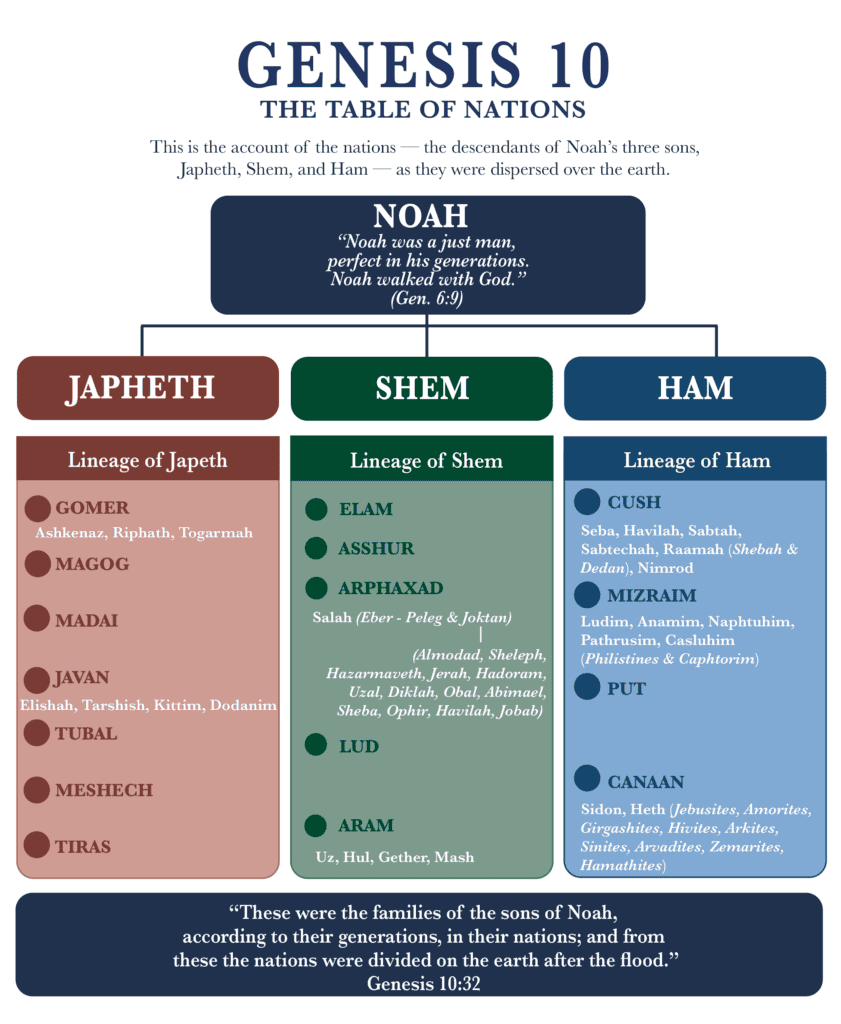
The purpose of this article is to provide the reader a basic framework to understand the meaning of Genesis 10 (the Table of Nations), the importance of the names it contains and the origin of nations.
The powerful God of the universe, Who created all that is, inspired the Bible in its entirety from Genesis to Revelation. In it are precious gems of truth laid deep inside for us to dig out. He has constructed a work, the Word of God, which is designed to exercise the human mind with the express purpose of ensuring that we inculcate within us His ways and thoughts. However, given all of the above, is it really important to understand and does it expand our knowledge of the Gospel? Indeed, is this chapter a part of the Gospel message in any way? Dr. John Pilkey thinks so:
“The descent of the nations from Noah is an interpretive crux intimately related to the evangelical Gospel” (An open letter of introduction in Project Genesis 10, No. 1, p. 4).
Further, Genesis 10 continues the story of people God has decided to covenant with –– that is, to enter into a relationship by creating the ground rules. He chooses whom He wishes to covenant with; mankind cannot choose to covenant with Him. As such, He selects His covenant people based on criteria He, in His wisdom, knows.
However, before discussing Genesis chapter ten, let us briefly encounter Noah’s Flood and also his three sons. Who they were and what can be learned from their names and their sons and grandsons’ names –– can their meaning have anything to do with modern nations?
All Nations Descended From Adam and Noah
All races of mankind have the same parents: Adam and Eve. According to Genesis 5:4-5, Adam and Eve had various sons and daughters (Josephus records the Jewish tradition that there were 33 sons and 23 daughters in all).
Undoubtedly, God created within Eve ova (egg cells) for each major race to ensure human diversity.
Thus, Adam and Eve’s children would have married each other, as there were no others to marry. They would have gravitated automatically to someone of like characteristics (skin color, physiognomy or behavioural patterns). Over time their descendants would have separated out into different races and nations, marrying into their own unique stock. A similar situation evidently arose again after the flood of Noah where the various races, sub-races and nations gradually developed as they inbred to create certain characteristics and natures in each. It was not wrong in the misty past for one to marry a close relative. Abram married his half-sister, Sarai (Genesis 20:12, 11:27-29) and Nahor married his niece, Milcah (Genesis 11:27-29).
Later God forbade such marriages as by then national characteristics were fully developed. Such unions had also become harmful genetically and socially and were therefore to be considered as “sin” with subsequent punishments (Leviticus 18:1-18). As such, all nations extant on the earth today may be traced clear back to Genesis 10 –– the table of nations.
The Table of Nations
This unique table is found in two separate places in the Bible –– Genesis 10 and 1 Chronicles 1 –– it is the key to understanding national history and prophecy. As such, it would behoove us all to read through these two chapters thoroughly. Further, it may be appropriate to consider what experts have to say on this important subject and I have several quotes following.
Professor Albright, a leading authority on Middle East archaeology wrote the following about this wonderful table:
“It stands absolutely alone in ancient literature without a remote parallel even among the Greeks … The Table of Nations remains an astonishingly accurate document … [it] shows such remarkable ‘modern’ understanding of the ethnic and linguistic situation in the modern world, in spite of all its complexity, that scholars never fail to be impressed with the author’s knowledge of the subject.” (Walter Albright, Recent Discoveries in Bible Lands, p. 4) [emphasis mine]
Von Fange adds to this: “The Table of Nations found in Genesis 10 is the most remarkable of all ancient genealogical documents,” (Table of Nations, unpublished paper, p. 1) and, “This chapter contains the oldest known ethnographic document in existence. It identifies, using location, language, or descent, the tribal groups that became the peoples of the world known in ancient times. Modern research has shown this table of nations to be a strikingly accurate record of nations and peoples that existed many centuries before the writing of the Old Testament.” (Larry Richards, Bible Difficulties Solved, p. 32) [emphasis mine]
It is truly a remarkable work, unsurpassed in world history. Another historian, Professor Hannay, states:
“… the Xth Chapter of Genesis is very well known, but I venture to think that the majority of those who know it are ignorant of its real nature”. (Herbert Hannay, European and Other Race Origins, p. xxv)
Professor Emil Kautzsch concurs:
“The so-called Table of Nations remains, according to all results of monumental explorations, an ethnographic original document of the first rank which nothing can replace” (Quoted by James Orr, “The Early Narratives of Genesis” in The Fundamentals, Vol. 1, p. 234) [ emphasis mine].
Professor Los similarly agrees:
“The Table of Peoples of Genesis X can, in respect of its ethnological value, hardly be valued highly enough. It is therefore very interesting that the grouping of peoples into families has been effected here in a manner which was unknown to the rest of antiquity and which only our own century has come into use again with the help of comparative philology.” (“The Table of Peoples of the Tenth Chapter of Genesis”, Mankind Quarterly, Vol. 7, No. 3 (1967), p. 151)
Jewish historian, Flavius Josephus, adds a little more to our knowledge of this mysterious “table” in his famous Antiquities:
“After this [Babel] they were dispersed abroad on account of the difference of their languages, and went out by colonies everywhere, and each colony took possession of that land unto which God led them, so that the whole continent was filled with them, both the inland and maritime countries.” (Flavius Josephus, Antiquities, Bk. 1, Ch. 5, para 1. Other nations are mentioned in Genesis 22:20-25; Genesis 25:1-19; 36:1-43.)
It would appear that the intent of this chapter is to inform readers of the Word that all nations descend from Noah and his three sons. And that further, God Almighty is the One who permits or even determines national destinies. The picture we get is that no matter how diverse mankind is, we all have a common origin having stemmed ultimately from Noah. See Genesis 3:20; Malachi 2:10.
Therefore, it should come as no surprise to us that the Bible contains this amazing genealogy of the family of nations as it does of others, such as 1 Chronicles 1 and Luke 1. Many societies and peoples have kept extensive genealogical records or censuses for a number of reasons (Nehemiah 7:5, 64; 12: 22-23). Similarly, God even has a Book of Life listing all of those with whom He is working (Revelation 3:5; 21:27).
God has not left out any major nation from the Genesis family tree, whether they are referred to directly or indirectly. He loves them all and no people is ignored. They are all mentioned in the Bible and history –– not under their present-day names, but under their ancient names. It is a list which incorporates all of the names of actual persons, tribes and places extant at the time of writing, projected into the past, based on historical records kept by Moses, under the inspiration of God Himself. “The tribal names stand for real individuals from whom the nations were believed to have descended” (Allen Ross, “Studies in the Book of Genesis, Part 3: The Table of Nations in Genesis 10 –– Its Content,” Bibliotheca Sacra, Vol. 138, No. 549 (1981), p. 34).
The great family tree from which every nation of the earth has sprung must be thoroughly understood if we are to trace each branch to their present locations. Bear in mind that it is God Who would lead them to their ultimate destinations, bless them or curse them.
Now why should this be associated with the Gospel as Dr. Pilkey maintained? It is because the Gospel concerns the future Kingdom of God on earth and the place all of the nations will have in that Kingdom. In other words, the future millennial rule of the Messiah on earth and the glory all nations will give to God in the knowledge that He is offering them eternal life. And it has to do with all those whom God is reaching on this planet, no matter what background, who are offered salvation as a free gift, should they repent and obey Him; as well as with who will receive the birthright and rule with the Messiah (i.e., Israel).
Of further interest is that, while many historians come with some baggage and are often-times imbued with nationalism or some philosophical or political bent, they are thus biased in their historical narratives. However, it may seem remarkable to them, if only they knew, that the historian Moses, author of Genesis including chapter 10, was remarkably unbiased. He is truthful and gives us a run-down of the sins and problems of the ancestors of Israel. This incredible restraint “suggests the hand of God upon him,” writes Arthur Custance (Noah’s Three Sons, p. 65).
Interpreting Genesis 10
There are several ways of interpreting Genesis 10:
● It is mere allegory and has no real substance or literal meaning.
● The chapter has geographic meaning and is not an ethnological account of ancient nations and modern identities.
● The Chapter refers to historical nations.
● It lists peoples (e.g., the Dodani or Kittim) and not mere place-names or names of individuals alone. It is primarily concerned with father-son descendants (tribal delineations) and has prophetic undertones. (That is the avenue taken in this article.)
Perhaps the majority of authors and researchers interpret Genesis as geographic representation of regions rather than literal peoples, including, to some degree, the famous Dr. Sayce. According to Archer’s A Survey of Old Testament Introduction, he was:
“… overhasty in surrendering the genetic reliability of Genesis 10 and interpreting it as merely a description of geographical relationships at a time when Canaan was under Egyptian domination … Even G. E. Wright … concedes that this list is arranged on the whole from a racial point of view” (Gleason Archer, A Survey of Old Testament Introduction, p. 212) [emphasis mine].
The fact is, either God’s Word is true and can be trusted, or it is without credibility. It is also of interest that God chose to scatter the nations at Babel for a number of reasons. And it should also be of interest that God used language as a means to scatter the nations. As any anthropologist or linguist will tell you, language is one of the primary modes of maintaining cultural transmission and ethnic identity.
As such, language is one of the ways of tracing the migrations and origins of peoples. And where did so many languages originate this side of the Flood? At the tower at Babel. God shattered the common cause of man, to ensure that man’s evil did not reach its climax prior to His time-frame. He frustrated their communication to undermine their common bond and thus divided or scattered them to ensure that they migrate to their destined and appointed portions of this wonderful earth (Acts 17:26) (Ross, ibid. See Psalm 55:9).
“From one man he made every nation of men, that they should inhabit the whole earth; and he determined the times set for them [when and which nation should have the pre-eminence] and the exact places where they should live [their specific location so that they might maintain their identity]” (Acts 17:26, NIV).
Identity of Nations Lost –– Until Today!
God led the human families to settle where He knows it is best for them. God would have taken into account the climate, weather, vegetation, and the proximity to like nations. He settled them in locations best suited to their potential, their characteristics, strengths and weaknesses and the Great God of the universe left traces and clues to their wanderings for us to discover today.
One major clue they left behind were their names, or traces of their names, which were given to various tribes within the nation or given to place names. It should be remembered, though, that sometimes several nations in history have similar names. For example, several nations were known as “Hittites.” (Donald Wiseman, Peoples of Old Testament Times, p. 197) Or the conflation by historians of Aramaeans with Amorites. This may cause confusion and has tended to “fox” certain writers on the topic.
Another point to remember is that the names of each of the forefathers of these nations reflect their characters and that of their progenitors. It is said that about half of what we are mentally (character, nature and personality) is inherited; and the other half is due to our environment. See James Nichols’, Heredity and Environment (entire book).
We are told in Scripture that: “A good name is to be chosen rather than great riches” (Proverbs 22:1, ESV) and “A good name is better than precious ointment” (Ecclesiastes 7:1, ESV). Thus, in the Bible, a name is something to be taken seriously, and not to be a word meant for phonetic beauty alone –– it was given as a sacred act (witness the naming of Israel and others in Genesis, Christ himself etc). It was not so long ago (a mere few decades) that it was believed that a name placed upon a newborn babe would result in it fulfilling the characteristics of the name. This is exactly what we find in Genesis 10.
One excellent article on this topic is by Susan Bean, “Ethnology and the Study of Proper Names,” Anthropological Linguistics, Vol. 22, No. 7, October (1980), pp. 305-16 which contains the following pertinent observations:
“… a proper name works, i.e. denotes an entity, because it has been rightfully bestowed and consequently ‘belongs to’ its bearer … For example, the Delaware Indians consider ‘a person and his name (are) one’ (Weslager 1971) … In many societies the personal name is considered to be part of, or identical with, the soul, self, or personality of its bearer … For the Basotho, a Bantu speaking people, the descriptive meaning of a name influences the character of its bearer ‘a man usually behaves in accordance with his name’ (Mohome 1972:171) … People in Surinam who behave badly may be said to have ‘ruined their names’.”
Just as many old societies knew this to be the case, these Scriptures are pointing out that a name has meaning. A name describes one’s reputation, one’s entire character. I will be discussing certain of the names of Noah’s descendants in sequels to this article.
For example, the descendants of Simeon and Levi, sons of Israel, are described as sometimes being a violent, cruel people, taking after their forefathers (Genesis 49:5-7; 34:24-31). But having certain characteristics which may be described as “negative”, is no excuse for anyone or any nation to behave unseemly. We should try and suppress the negative, inherited traits within us, and instead reinforce those which are positive. We must overcome ourselves. All humans are born with ingrained traits, but unlike animals, our traits do not have to overwhelm us; once we become aware of them, we can choose to go with them or to go in a different direction. Our instincts were made extremely weak in humans so as to allow us to be free moral agents. Behavioural scientists and social engineers have seized on this to try and mould men into the image that they wish us to be.
As we have seen, in the Bible a nation is named after its ancestor. And so it was most often in the classical world. As they migrated, the nations were given new and different names by observers –– friend and foe alike –– so that they even changed their own names eventually. But many kept their original names until recent centuries. Dorothy Astoria in The Name Book maintains the ancient tradition and understanding that:
“Your name is a very important aspect of your personality, and this book has been compiled so that you may recognize the character-building value in understanding its meaning …
“Our Western culture does not give the same importance to the meaning of names as has been given in the past … Each name carries its own message … the heritage, significance and spiritual application inherent in a name” (p. 5).
As the language of nations changed, gradually, over the decades and centuries, so did their names. However, as we shall be discovering, it is quite possible to trace their names back through history to the original. For further information on the Biblical perspective of names refer to Arthur Custance’s book The Flood: Local or Global? chapter 1, “Names as Different Societies Have Viewed Them” and chapter 2, “Names as Scripture Views Them”.
Time, language change, corrupted traditions, lies by their enemies –– all this has helped conceal the identity of the nations. Even many of the books on this subject published prior to circa 1930 which were not overly influenced by atheistic evolutionary theories are not all that helpful. Evolution is a theory which has openly attempted to deride the Biblical, historical and traditional accounts of national origins.
Why then, is this Table so important? Allow me to list several reasons:
● Chapter 10 of Genesis reveals God’s will and His plan for the nations.
● It gives the correct classification of nations.
● The Table proves the Bible to be inspired.
● Finally, it reveals the future of the nations when linked with relevant prophecies. When we know the true identity of nations then we can understand prophecy. The Bible reveals history and wars to be titanic struggles between races out of greed or the will to survive, and not just between conflicting ideologies.
It is not studied much nowadays, but was certainly popular from the 17th until the early 20th centuries. Scholars such as George Stanley Faber (see Burton Feldman & Robert Richardson, The Rise of Modern Mythology. 1680-1860, pp. 396-99 [chapter on George Stanley Faber]) Samuel Bochart, Alexander Hislop, Jacob Bryant and others thought deeply on this subject and developed some fascinating material. But with the rise of Darwinism, “mythography” died and modern ideas on man’s origin arose, clouding and deceiving the true origin of man and his various races, sub-races, nations, ethnic groups, tribes and clans.
Others who have shown an interest in this great truth are Arthur Custance, Archibald Sayce, Bill Cooper, George Rawlinson, Herman Hoeh, John Pilkey, Robert Gayre of Gayre whose works you can seek out at your leisure. They provide some formative information that can be used in basic research into this topic.
Noah’s Three Sons and National Prophecy
Let us dig deep into His precious Word and discover yet more of His truth.
In the book of Proverbs, we are told:
“… yes, if you call out for insight and raise your voice for understanding, if you seek it like silver and search for it as for hidden treasures, then you will understand the fear of the LORD and find the knowledge of God.” (Proverbs 2:3-5, ESV)
“It is the glory of God to conceal things, but the glory of kings is to search things out.” (Proverbs 25:2, ESV)
These Biblical principles are of great value for a Christian to hold on to. The Word of God has hundreds of references to the positive attributes of knowledge. However, those who wish to water-down the truth, will almost invariably turn to 1 Corinthians 8:2, which states that knowledge puffs up. However, they do not look at the context, for it is referring to worldly knowledge, not God’s Word or positive knowledge. They also seem to always turn to 2 Corinthians 11:3, which encourages us to have the “simplicity that is in Christ.” By so doing, they try and intimate that we must not study the depths of God’s Word as it is too complicated. Can you believe it? The original Greek in 2 Corinthians 11:3 should actually be translated as “guilelessness,” not “simplicity.” God does not wish us to be simple (“How long, O simple ones, will you love being simple? How long will scoffers delight in their scoffing and fools hate knowledge?” Proverbs 1:22, ESV)
Then, of course, they turn to Ecclesiastes 12:12 which says, “My son, beware of anything beyond these. Of making many books there is no end, and much study is a weariness of the flesh.” (ESV) They do not see that it does not say that you shouldn’t write books; and it does not say you shouldn’t study. It means that too much study causes weariness –– something that few would have a problem with, except students. But let us understand Scriptures in their Biblical context, such as: 2 Timothy 2:15; 1 Timothy 4:13; Proverbs 15:28; 25:2; Acts 17:11.
Why Prophecy? A Second-Rate Subject?
Why is it that the constant excuse from some quarters is that all we need at this time is for sermons on Christian living alone? As if prophecy, typology and other vast areas of His Word have nothing to do with Christian living. Of course, detailed, accurate prophecy is closely related to Christian living for the following reasons:
●It keeps the bride excitedly anticipating the bridegroom (Matthew 25:1-13).
● Prophecy leads one to repentance and a close relationship with Him (this is the theme of the prophets and the greatest prophet of all, Jesus Christ).
● If we understand prophecy, we will be in a position to escape the terrors which will descend upon the earth. We are charged to watch (this includes watching world events, the wish-washy condition of the Church, and our spiritual states i.e., Luke 21:36; Matthew 24:42; 25:13).
● As we are living in the Latter Days, it behooves us to know the signs of the times and how world events line up with prophecy to enable us to warn a sick and dying world (Ezekiel 3:17; 33:1-7; Jeremiah 6:17, 27).
● “Where there is no vision the people perish” (Proverbs 29:18). The Revised Standard Version translates “vision” as “prophecy.” The Hebrew word hazon is translated similarly elsewhere (see 2 Chronicles 32:32; Daniel 8:1; Obadiah 1). Should we neglect these futuristic warning words of God, we will perish (see 1 Samuel 3:1; Lamentations 2:9).
● It is a major proof of the Bible.
● Prophecy, by its very nature, encourages us to want to dig deeper and deeper into God’s Word, to uncover its other precious nuggets.
The Apostle Peter wrote: “And we have the prophetic word more fully confirmed, to which you will do well to pay attention as to a lamp shining in a dark place, until the day dawns and the morning star rises in your hearts” (2 Peter 1:19 ESV. See 2 Corinthians 4:6.)
I see nothing in Peter’s statements which legitimizes the watering-down of His truths or prophecy. With that said, let us explore an aspect of God’s Word which many have watered-down tremendously.
In the next installment of Origins of Nations, we will continue to examine this exciting topic, concentrating on some of the descendants of Ham.