Thankfully, the majority of us know nothing about being thrown into prison for our beliefs. Yet that is precisely what had happened to Peter. And it was not only a prison, but a high security situation as well. King Herod had assigned no less than SIXTEEN soldiers to guard this “dangerous” fellow! You can follow the story in Acts chapter 12.
A “quaternion” was a set of four soldiers. Commentaries point out that this amounts to 24 hour surveillance, with a set of four soldiers serving during each of the four night watches. A remarkable security measure for the time and yet, just to make sure, Peter was also kept CHAINED. This in addition to the regular keepers of the prison. That is a lot of Roman soldiers doing duty over this unarmed man.
Herod Agrippa had a fearsome reputation. He had already “killed James the brother of John” (v. 2) and, seeing the positive reaction from the Jews, decided to target Peter next. He wanted to gain popularity and favor with the Jewish leadership, the Sadducees and Pharisees.
He planned to hold a public trial and execution of Peter after the Passover (Acts 12:4). This is mistranslated as “Easter” in the KJV, but the majority of English translations render it correctly. Further, the entire 7 days of Unleavened Bread (Leviticus 23:5-8) is implied. Jerusalem would still be crowded from the festival, a great opportunity for Herod to flex his power and gain favor.
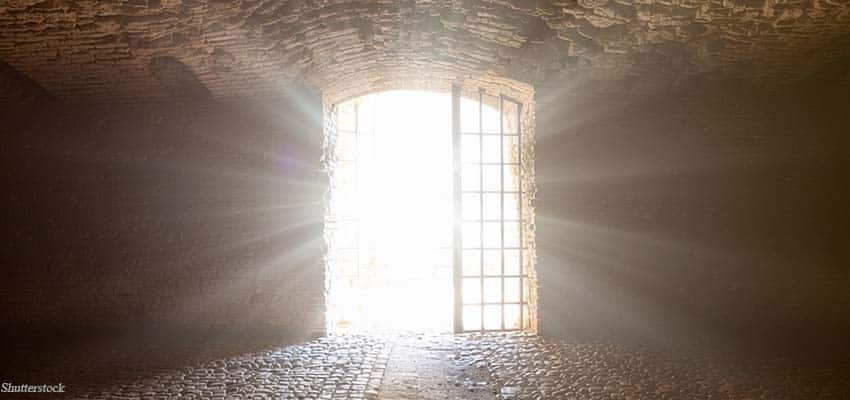
But then there is another, GREATER source of POWER. Of Peter we are told, “PRAYER was made without ceasing of the church UNTO GOD for him” (v. 5). On the VERY NIGHT of Herod’s plan, “the angel of the Lord came upon him, and a light shined in prison: and he smote Peter on the side, and raised him up saying, ‘Arise up quickly.’ And his chains fell off from his hands. And the angel said unto him, ‘Gird thy self, and bind on thy sandals.’ And so he did. And he saith unto him ‘Cast thy garment about thee, and follow me.’ And he went out and followed him…” (verses 7-9).
Wake up, get dressed, let’s go! The story is so authentic in its details. How would you rouse a sleeping man and make him move in a hurry? The angel “smote” him (gave him a whack to wake him up), helped him to his feet and urged him on! Decisive action for a divine messenger.
And how many miracles occurred to help Peter escape? Not only did an angel speak to him, and get him up and going, but he saw a bright light. Likely quite a shock to eyes that had been resting and adjusted to the dark. Furthermore, the chains fell from his hands.
At this point, Peter’s mind hadn’t caught up to the action. He must have wondered, “What is going on here?” Verse 9 says he “wist not that it was true” and “thought he saw a vision.” He didn’t think he was actually getting out of prison!
Yet on they went. They walked out of the cell, past the other wards, miracle after miracle. And when they came to the main iron gate that led to the city, IT OPENED TO THEM OF ITS OWN ACCORD! Not exactly a desirable feature in a prison gate. The man who had assigned so many guards, going to such great lengths to keep Peter locked up, was not going to be happy!
Once outside, Peter finally began to realize what was happening (v. 11). His eyes weren’t lying to him, it was not a dream or a vision, God had delivered him from Herod and those who would rejoice at his death! Truly, it was miraculous.
He had seen a bright light, all the more astounding in the days of oil lamps and torches. The iron chains had simply fallen from his hands. The gate opened before his eyes. As the reality of it all sank in, Peter knew exactly where the great power to accomplish all this had originated.
But Peter wasn’t the only one who was going to have difficulty processing these overwhelming, sudden and unprecedented acts of God! Like all of us, when something wonderful happens we want to tell our family and those we are close to. In this case, Peter went to those in the church, “where many were gathered together praying” (v. 12).
When he arrived, he knocked on the door. We are told a damsel named Rhoda came to see who it was and recognized his voice. But then the obvious did not happen –– she did not let Peter in! Instead she ran to tell the others. Did they rush to see him, rejoicing over their answered prayers, thanking God and singing hymns of praise? No! Instead they said, “You’re mad!”
Is it crazy to think God had heard their requests and granted them? It did say “prayer was made without ceasing” in verse 5, and verse 12 indicates Peter pretty much interrupted it when he knocked on the door.
Rhoda stuck to her story though; “She constantly affirmed that it was even so” (v. 15). How long did they bicker? Someone came up with a reasonable explanation: it’s not Peter –– it’s his angel. Anything other than Peter actually being delivered from Herod and from prison, the very thing they had prayed for. That just CAN’T BE!
Thankfully Peter didn’t give up. He settled the matter for them. “But Peter continued knocking: and when they had opened the door, and saw him, they were astonished” (v. 16).
It is a classic tale of UNBELIEF. Peter, at first, is not sure that what he sees is actually happening. Once he is free, the whole group who had been faithfully praying for him somehow failed to believe God had heard and provided for Peter’s safety.
There were some that didn’t doubt Peter’s escape. When morning came, “there was no small stir among the soldiers” (v. 18). Herod even got personally involved. He had a look around for Peter himself, to no avail, and “examined the keepers and commanded that they should be put to death” (v. 19).
A humiliating result after all his precautions, all the soldiers he had detailed to make sure Peter wouldn’t escape. Herod left town and soon met a hideous fate after allowing himself to be praised as if he was God (v. 22-23).
Where are the lessons in this tale for us? It is a testimony to the power of God over every wicked device of man. Imprisoned for the truth and set to be executed, all to gratify a vain ruler and a corrupt religious establishment, Peter had the full power of civil authority against him. Every precaution was taken to keep him locked up. Yet Peter walked straight out under the protection of the Almighty.
“Thine, O Lord is the greatness, and the power, and the glory, and the victory, and the majesty: for all that is in the heaven and in the earth is thine; thine is the kingdom, O Lord, and thou art exalted as head above all” (1 Chronicles 29:11).
And He is on the side of the righteous. It is to Him that the church prayed for Peter’s life and, despite their incredulity, those prayers were answered. When we beseech Him, when there is no human way around a problem, why do we doubt that He will both hear and answer?
Christ said, “All things, whatsoever ye shall ask in prayer, believing, ye shall receive” (Matthew 21:22). This is true no matter the obstacle we face. Herod had great power and authority, but when he persecuted the truth and blasphemed God the result was catastrophic. Be comforted by this story of deliverance, and don’t be surprised when the mountain tumbles into the sea.