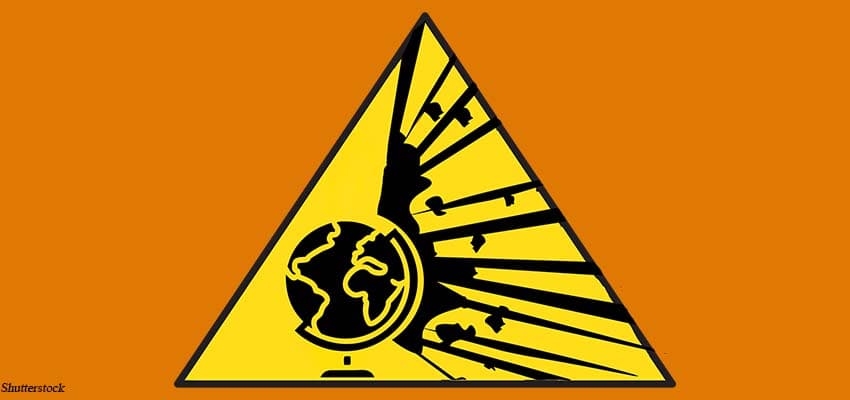
For all their complexity, world affairs at this time could be summed up with a single word: PRESSURE! Everywhere there is the feeling of simmering tension. Great powers find their agendas at odds, internal strife rattles the foundation of civilization. The past, the present and the path forward are everywhere the subject of contentious debate. One gets the impression of a soda that has been dropped or shaken. How can the pressure be released without making a tremendous mess?
Of enduring interest are the Epstein files. They are continuing to add to an already staggering list of high-profile resignations or at least humiliations. The arrest of the former Prince, Andrew (or “the Andrew formerly known as Prince” if you’re the right age for that reference) was shocking if not entirely unexpected from his long and documented relationship. The UK Ambassador to the US, Mandelson, was arrested in the days following and both are facing scrutiny for alleged abuse of public office at the very least.
But the list goes on and on. Resignations include: A former US Treasury Secretary and President of Harvard. Goldman-Sachs’ chief legal officer. The President of the World Economic Forum. The Chairman of Hyatt Hotels. We could fill the page with them. Bill Gates has even had to publicly admit to affairs with multiple Russian women and apologize profusely to save face at his foundation. The effects are rippling around the world as many other countries see executives and government officials bow out of important roles after their names appeared in the files.
The real fallout is in trust. The governmental systems and large corporations that underpin the world order as we know it today are reeling from this. And in no way is this a plea for the status quo. Let justice be served in every circumstance. From a prophetic viewpoint it is the potential for change that is of primary interest. What shifts the current establishment towards the final scenario? When the population as a whole begins to regard those who hold the levers of power as not only self interested or corrupt, but evil and guilty of some of the most heinous crimes imaginable, the odds of dramatic change increase exponentially. Already there are mobs crying for blood in a sense. Demanding the cancellation of contracts, firings, prosecutions and so on. But the mob’s appetite, once whetted, is not easy to satiate.
By no means is that the only issue contributing to the tremendous pressure in world affairs today. Since the last publication of this magazine we have seen the daring raid that plucked Nicolas Maduro from the Presidency of Venezuela. The audacious action was not only a display of military prowess but a slap in face to Venezuelan allies like China and Russia, who spent enormous amounts of time and money cultivating influence in the country.
The repercussions have been even worse for Cuba. That country now teeters on the brink of collapse. Venezuela was traditionally their main supplier of oil, which they burn to generate electricity, and it has been completely cut off in line with US embargoes. Mexico, the next largest, has been pressured by the US to stop deliveries as well. Fuel shortages, power outages and a want of other necessities are testing the resilience of the communist regime.
Mexico has also caved to US calls for taking action against the cartels, notorious for the production of drugs, smuggling and human trafficking. A raid was carried out against “El Mencho,” leader of the Jalisco New Generation Cartel, that saw him killed in the process. But bloodier still were the repercussions that followed. It is estimated that over 70 people have been killed as of this writing, a third of which were military or law enforcement. They have been targeted and ambushed in retribution. Further, roads were blocked and businesses burned in over half the country as the cartel flexed its muscle, attempting to intimidate the authorities and deter future action.
We will see if more is being contemplated. The problem is obviously far from solved. Mexico has resisted direct US involvement as insulting to their sovereignty, but the military has provided intelligence to facilitate operations. A crackdown on cartel leadership may set off power struggles that actually result in an increase in violence, as has been seen in Ecuador over the past couple of years. We can only guess at how deep the corruption goes as well. That may have a detrimental effect on seeing these elaborate and powerful criminal operations completely eradicated.
Gaza also finds itself at a bit of an impasse. Hamas theoretically agreed to disarm once an acceptable international force was in place and other steps towards sovereignty had been taken. No international force has been forthcoming. Indonesia was the first to agree to participate, a development that came about during trade negotiations with President Trump. Turkey had indicated a willingness, but Israel did not want to be put into direct military confrontation with them due to their mutually contentious history.
Therein lies the danger from which Indonesia, the world’s most populous Muslim country, is not exempt. Any nation that participates risks putting their forces into an extremely volatile situation and opens up the potential for conflict with Israel. Nor can they be sure their soldiers don’t harbor any personal animosity that might be acted upon if an opportunity presented itself. Hatred for Israel runs deep throughout the region. Most Arab countries want no part of a peacekeeping mission under such tense circumstances, let alone the prospect of being drawn into a wider war. Prophetically, Christ said Jerusalem would be surrounded by armies prior to the last days (Luke 21:20-22), making this region especially important to WATCH!
Iran has just boiled over at this writing. Israel and the United States are currently conducting strikes all over the country. The Ayatollah has been killed and the regime’s senior leadership has been decimated. No one knows how long the strikes will continue. The people have been encouraged to rise up and take control of their government in the aftermath. Iran has long received support from Russia and China in an “enemy of my enemy” sort of way. It has been an export market for Russia in the face of Western sanctions and a cheap supplier of oil to China for the same reason. With the discount likely to evaporate on Venezuelan crude, China may resent a similar fate befalling its allies in Iran. Time will tell. China and the US are currently playing nice ahead of a summit between Trump and Xi.
Four years later, the war in Ukraine grinds on. It has revolutionized battlefield tactics with the use of drones. Russia has demanded more territory than it currently controls as a prerequisite to peace, something Ukraine is not willing to accept. Russia continues to advance, but the advance is extremely slow and the cost in lives and equipment is extremely high. Small squads are sent to quickly penetrate the front lines, but they are often driven back by an onslaught of drones that is difficult to defend against. The conflict is currently one of attrition, each side hoping to wear the other out.
Most of Europe remains vociferous about the threat from Russia. But not uniformly. Hungary vetoed two measures recently, one was a loan for Ukraine and the other was a new round of sanctions on Russia. It is a poignant illustration of the divergent interests that exist across the bloc and adds internal drama to external pressure. Another would be Spain offering blanket amnesty to migrants, providing an easy way into the Schengen Zone when most members are tightening their restrictions. Many of these nations are the literal and prophetic heirs of the old Roman Empire and many of the fault lines between the Catholic West and Orthodox East can still be clearly seen. The current EU lumps all that together and more, but it is an imperfect union that will not stand the test of time in its current form.
The United States is facing internal difficulties of its own. Immigration enforcement, particularly the deployment of ICE in ideologically opposed cities, resulted in many protests and a couple of high-profile deaths. The narrative that gets reported around these incidents differs wildly depending on the outlet. The issue has almost become one of emotion rather than reason or propriety when dealing with law enforcement, as if protesting somehow allows you to act with impunity. Thankfully, much of the clamor around this has died down. Polls have shown the country is still broadly in favor of enforcing our immigration laws, including deportations. Yet that support slips for the actions necessary to carry it out, essentially wanting the job done but not wanting to do it. Deportations continue, including incentivized self-deportations, and illegal border crossings have dropped to virtually zero.
The Supreme Court’s long awaited ruling on Trump’s tariffs was finally handed down, and not in his favor. That decision temporarily injected uncertainty back into the trade situation but it has largely stabilized. Even critics do not doubt Trump’s ability to reset tariffs to the agreed upon levels via different, though slower, methods than the emergency power he had enacted them under. The vast majority of deals negotiated show no signs of breaking, and much of the foreign investment that was set to be approved will continue even as the legal framework is rebuilt. Trump claims he has secured upwards of $18 Trillion in foreign investment since taking office.
The re-assertiveness with which the US has pursued its agenda is an over-arching factor in many of the pressurized situations we have discussed. For years there has been talk of a “multipolar world.” The era of American dominance, as the only superpower after the collapse of the Soviet Union, had been read its last rites. That notion has been completely turned upside down.
Enemies and allies alike have taken notice. There is no substitute for American military power, market access or leadership. It is not a boast or an egotistical delusion to say so. It is a cold, hard assessment of actions taken and the subsequent international reactions. The world has no replacement as of yet. That fact alone places us at the center of a great deal of volatility.
Tension and pressure are building in many places and in many ways. It remains to be seen how much of it will be managed. Can it be dispersed incrementally? Will it explode suddenly into war and tribulation of Biblical proportions? We can only remain vigilant, devoted to the calling and example of our Lord Jesus Christ, and faithful to His instruction to WATCH and PRAY!