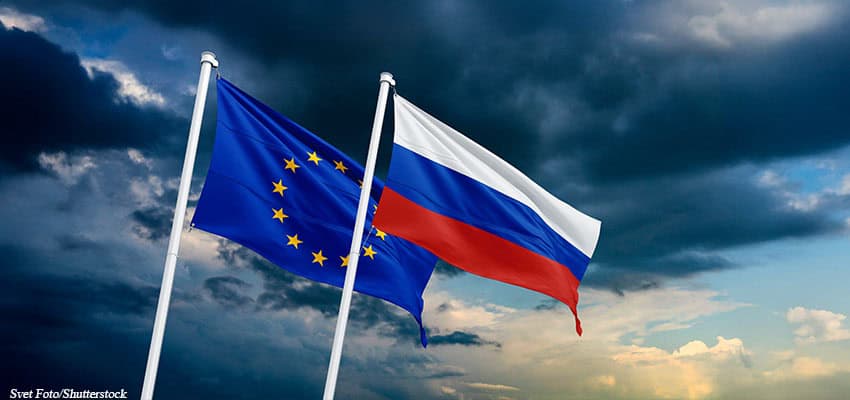
Will a terrible alliance between Europe and Russia eventuate, threatening the very existence of the Anglo-Keltic realm and associated nations? Could a shock rapprochement and close cooperation between a German-led Europe and Russia ever transpire? A look at history may reveal important clues to the future.
It is important to have a bird’s eye view of world developments as well as an historical perspective. Otherwise, one can get carried away by current events which seem to be taking the world quickly in a certain direction.
This article has been written based on the historical big picture –– that is, looking at history and cycles –– which reveals that a future German/European/Russian axis will likely develop despite the current tensions over the conflict in the Ukraine. Most cannot see this now, of course, but history tells another story as shall be revealed below.
People have made all sorts of predictions surrounding the COVID outbreak, the rise of Islam, a new world order, and so on. None of them have come to pass, nor will they in accordance with their perspective.
Similarly, there are great tensions between European nations and Russia which commenced long before the Russian invasion of the Ukraine. These tensions have dragged on for many years, and are escalating, leading some to get excited that a war is about to break out ushering in the Great Tribulation.
It is not that these prophesied events will not happen, but because observers often do not have a “helicopter view” of world events combined with history and prophecy. They do not have a “big picture” overview, but are stuck in the moment, merely watching current events and trying to slot them into prophetic pigeon-holes. This has not and will not work because of the lack of understanding of timing, sequences of events, and the lack of historical perspective.
For those who know this writer and have read his writings, he has always maintained that we need to look at history as a template for future developments as there are cycles and rhymes that can be observed. Based on the aforementioned principles followed by an attempt to project these into the future, we can be reasonably sure of what to expect.
In this context, we need to have a discussion about the current European/German tensions with Russia and whether they will last long.
The relationship between Germany and Russia is arguably one of the most dramatic among nations, characterised by significant fluctuations throughout modern history. This relationship has followed a cyclical model, oscillating between alliances and warfare, periods of rapprochement and tension, as well as cooperation and conflict. Over the past 150 years, German-Russian relations have played a crucial role in shaping the course of European history.
The two economies have been interdependent. Germany produces the industrial chemicals and machinery essential for Russia’s economic modernisation. Until recently, Russia supplied enormous quantities of natural resources to European economies. It is likely that this will be revived. The two economies are a lot more dependent upon each other than they currently are willing to admit, in addition to all they have in common culturally.
Europe’s Current Dilemma
Europe and its leading nation, Germany, have been emasculated; men are not tough, the people are weaklings, society is woke, globalisation and mass immigration are designed to destroy Europe and Western Civilisation.
Writing for the conservative Quadrant website, Oliver Hartwich lamented:
“The combination of Merkel’s sixteen years and Scholz’s three has left problems too deep for quick fixes. That is the price Germany must pay for too many years of politics without leadership.
“I cannot help but see Germany’s trajectory as a cautionary tale for other Western democracies. It is what happens when nations prioritise short-term political management over long-term vision, grow complacent about their achievements, and allow their core infrastructure, security and economic structures to decay.
“I wonder if I will ever again recognise the country of my birth as the Germany I knew.” (“German Götterdämmerung”, Quadrant online, 3 April, 2025).
Another article in this context worth a read is “Germany and the Future of National Populism” on The Liberal Patriot blog, 24 March, 2025 by Henry Olsen.
This has been going on for decades and something has to give. The entire system including the judiciary, big business, bureaucracy and political parties are far left/woke/globalist and this has to change.
But there has been a groundswell for over 20 years to reverse this trend –– an increasing tide that is beginning to move in one direction while the elites are trying to keep it down. One day it will surge in Europe and Germany with the right leadership. A new form of globalism and cooperating nations, rather than a world melting pot, will emerge; family values and conservative religion will be restored.
Hitler did just that after the decadence of the Roaring Twenties which lasted 10 years. But we have had 60 years of decadence that society needs to purge and for leaders to align with a conservative sentiment.
Today’s groups in Europe such as the AfD, Freedom Party, National Rally, Reform Party, etc. are old-fashioned conservatives and in no way “far right.” But could they eventually move far right? Perhaps, under circumstances such as a world-wide economic depression or gaining power and deciding to hold on to it to ensure the reversal of wokeism due to their longing for old Western values, together with restoration and expansion. Will it be a gradual slide toward extremism or other forces that save Europe?
When we look back at Napoleon, Mussolini and Hitler, they pushed back at the “left” of their day while simultaneously adopting economic and social models that were meant to uplift their peoples. To a degree, Bismark and Wilhelm II did similarly.
The eventual European leader will be unlike Hitler initially: someone of noble or royal European lineage and who is classy, diplomatic and captivating. A leader of a European Confederation with a single treasury and military. Not a United Europe of forced integration and the end of national diversity.
Europe has been put to sleep –– in a planned and well organised way, by the intelligentsia. It needs to wake up from its slumber and there are clear indications of this stirring. A clamp has been gradually strangling Europe from reviving and thus resisting the left, but the yoke will be removed. Europe will be emancipated!
An influence may come from the more conservative nations of eastern Europe and even conservative Russia. Europe and Russia need each other now more than ever and they will awaken to this political rapprochement in due course.
Historical Affinity and Rivalry
Much of what is being discussed herein has ancient roots. As Rome split into eastern and western regions, the eastern one was usurped by the Macedonian, Serbian and Bulgarian kingdoms. With the fall of Constantinople in 1402, two small states continued the Eastern tradition, Trebizond and Nicaea. Later, the Byzantine Empire was restored but fell to the Turks in 1453.
However, some aspects of the Eastern Empire transferred to Imperial Russia under the auspices of Ivan III (reigned 1462-1505, often called “Ivan the Great”) who was regarded as the first national sovereign of Russia. Even Peter the Great (reigned 1682-1725) claimed to continue the Eastern Roman Empire and became known as the Czar (Caesar) of “all the Russias.” But it was truly the nations of central Europe (Mitteleuropa), more-or-less within the lands of the Habsburgs, that inherited the eastern leg. These became known as the Austrian Empire (Österreich) after the abolition of the Holy Roman Empire, and later still the Austro-Hungarian Empire in the 19th century.
“By his marriage in 1472 to Zoë (Sophia), niece of the last Byzantine emperor, Constantine XI Palaeologus, Ivan also made creditable his claim to be the protector of the Orthodox church. Soon after his marriage Ivan added the two-headed eagle of the Byzantine escutcheon to his own coat of arms and modelled his regime on that of the autocratic Byzantine rulers, and drastically curtailed the powers and privileges of the other Russian princes and the Russian aristocracy. Ivan also issued the first Muscovite legal code in 1497.” (“Ivan III Vasilyevich,” Microsoft Encarta).
His marriage to Zoë was arranged by the Pope in the hope of bringing the Russians into the Roman church. Instead, “The marriage was of importance in establishing the claim of Russian rulers to be the successors of the Greek emperors and the protectors of Orthodox Christianity (theory of the Three Romes, of which Moscow was to be the third and last … Ivan took the title of Tsar, i.e. Caesar and the practice of court ceremonial).” (William Langer, Encyclopedia of World History, p. 342)
So, some aspects of the Eastern Empire were transferred, politically, to Russia and it may be that this was a cause of friction between the old Holy Roman Empire (as well as the Austro-Hungarian and German Empires) and Imperial Russia. It may be again if and when the history and heritages of Europe and Russia are revived in opposition to modern wokeism and the ideology of globalisation.
This rivalry and “love-hate relationship” is ongoing. History informs us that it may be a “love” relationship in the not-too-distant future because the two sides really do need each other.
There is a very strong possibility of a German-led United Europe and Russia closely cooperating for some time prior to their falling out yet again in accordance with historical rhythms. Watch for a United Europe developing an antagonistic approach toward the Anglo-Keltic led nations.
In an article on this German-Russian relationship, Birgit Görtz outlined the “Millennium of love-hate” between Germans and Russians (Deutsche Welle, 5 October, 2012). Written thirteen years ago, he explained that the relationship between Germany and Russia at that time was far from friendly. However, an exhibition in Berlin highlighted that throughout the last millennium, the two nations have not consistently been adversaries; there were periods when they enjoyed a strong friendship.
Let us explore some of this, because Germany is destined to lead Europe back to dominance. As a proportion of the population of the world, Germany has declined significantly since World War 2. Especially Prussia in the east, now with only around 16.4 million inhabitants. The economy is a mess and debts are shocking. Society is breaking down.
Germany needs the other nations of Europe to be powerful again as it cannot be a world power on its own. It also needs Russian assistance. This may sound a little odd to the reader due to the war in Ukraine and the current antagonisms between Russia and the majority of nations that consist of the European Union. But who says this will last?
History may provide a model that we can observe which can lead us to understand the future. Current events are the moment we are living in –– they are not the overall picture.
Historical Precedents
The relationship between the Germans and various European nations on one hand, and Russia on the other, has been rather convoluted. Dating back to the 1300-1500s, the Teutonic Knights (close entities with the Holy Roman Empire) invaded the Baltic area and part of what became known as Russia.
Overall, though, engagement between Europe and Russia was limited because the Holy Roman Empire was primarily concentrated on Central and Western Europe. In those days, geographic separation between the Holy Roman Empire and Russia (historically referred to as Moscovia), resulted in rare instances of direct political or military engagement.
Additionally, the Holy Roman Empire was predominantly a Western European entity characterised by a strong Catholic cultural identity, in contrast to the distinct cultural identity of the Russian territories.
Note, though: “Germany, of course, has exerted an enormous influence on Russia down through the centuries, although neither Russians nor Germans like to admit it. Germans have ruled Russia (they even institutionalized favoritism: “Bironovshchina” during the rule of Tzarina Anna [1730–40]); they constituted the most successful part of its military and commercial corps; they raised the Tsar’s children and colonized Russia’s barren lands. In the 19th century up to half of all governors and high-ranking army officers in Russia were of German descent. When Tsar Nicolas I asked the conqueror of the Caucasus, General Yermolov, how he wanted to be rewarded, the general reportedly replied, ‘Your Majesty, make me German!’ At different points of Russian history, the ‘German factor’ had a substantial effect on Russia’s trajectory. Had it not been for this factor, Russia might have moved in a whole different direction.” (“Russia’s Love Affair with Germany” The American Interest, 27 August 2015, by Lilia Shevtsova) [emphasis mine]
The influence of German born Catherine the Great who reigned as Empress of Russia (1762-96), cannot be under-estimated. The expansion of the Empire, modernisation together with military and economic reforms, greatly assisted with the development of the country. She imported around 30,000 Germans with the number eventually swelling to 2.4 million by the 1980s. Today only 500,000 still live in the countries of the former Soviet Union.
For over 200 years, Napoleon (whose empire was joined by the western portion of the Holy Roman Empire) followed by Germany, entered into various treaties. Let us take a closer look at this, and based on history, predict if this is possible again.
• The Treaties of Tilsit (1807): was formalised between Napoleon and Tsar Alexander I of Russia which concluded the War of the Fourth Coalition and initiated a Franco-Russian alliance, although this alliance deteriorated over time.
• League of the Three Emperors (1873): founded by Otto von Bismarck, which included Russia, Germany, and Austria-Hungary. However, following Bismarck’s removal from office in 1890 by Emperor Wilhelm II, his successors opted to align with Austria in its rivalry with Russia for dominance in the Balkans. This decision ultimately led Germany to engage in conflict with Russia during World War I from 1914 to 1918. (NB: there was no formal treaty for the League, but a series of agreements and diplomatic initiatives).
• Reinsurance Treaty (1887): this confidential agreement orchestrated by Bismarck between Germany and Russia and backed by Wilhelm II, sought to preserve peace in Europe by guaranteeing mutual assistance in the event of an attack by France on Germany or Austria on Russia.
• Treaty of Björkö (1905): a brainchild of Wilhelm II. This secret military treaty was destined to be an unsuccessful endeavour and did not last long.
• Treaty of Brest-Litovsk (1918): the treaty, concluded between Russia and Germany, signified Russia’s exit from World War I and resulted in substantial territorial losses for Russia to Germany.
• Treaty of Rapallo (1922): this accord, signed by Weimar Germany and Soviet Russia, re-established diplomatic relations, renounced any territorial and financial claims, and initiated trade partnerships.
• Molotov-Ribbentrop Pact (1939): often referred to as the Nazi-Soviet Pact, the agreement encompassed a ten-year non-aggression treaty between Germany and the Soviet Union, along with clauses for economic collaboration and territorial expansion. There were even attempts to bring the Soviets into the Germany-Italian-Japanese Axis, but this failed. Prior to this, the Russians permitted Nazi pilots to train in their country; while the Nazi pilots in turn, trained the Russians.
History Repeats, Does It Not?
In this regard, I wrote to the esteemed and famous Professor Anthony Sutton (1925-2002) over 40 years ago about the possibility of cooperation between a future United Europe and Russia. In response he wrote the following in a letter to me dated 17 December, 1984:
“From the facts you present it seems we agree that Europe will become a united socialist federation cooperating with a Soviet Russia. This ultimately must isolate the United States.
“My guess is that the real challenge will come after the year 2000. It will pose a weakened United States versus the rest of the world. A sad but seemingly inevitable fate.”
At that time I thought that Russia might evolve into some sort of Imperial power and that someone from royal stock might become the focus of the nation as part of a constitutional monarchy to unite all the tribes and nations of Russia. It was not going to last as a Communist or Soviet system.
Also, that Europe was going to eventually turn extreme-right while America and the Israelite nations would turn extreme-left. Instead Europe went in the opposite direction (as did America, Britain, et al.) until the rise of Trump to (temporarily) arrest this trend. However, in Europe there are strong undercurrents to push back the Continent to the to the centre. From there, under all sorts of pressures and duress, Europe will move to the real extreme-right and find its natural ally in a right-wing Russia. My view is that this is still going to occur some day.
European Defence Force
This naturally leads to a brief discussion of an approaching European Defence Force. But let’s not get too excited or ahead of ourselves. In an article titled “Europe’s half-baked rearmament boom is already turning into a fiasco” published in The Telegraph, 26 March, 2025, renowned editor and journalist, Ambrose Evans-Pritchard reveals how tenuous all of this is. Yet it is a start.
This writer does not agree with Evans-Pritchard’s assessment of Trump himself but agrees that the rearmament of Europe looks less impressive than originally presented. It will take some time to implement and to become a threat to the immense power of the United States with its technological advantage and huge bases around the world, etc.
Because Germany spent $1.8 trillion to modernise East Germany, much of infrastructure spending for West Germany was abandoned for decades. Now that the debt ceiling has been lifted by $1 trillion, the SPD have pressured the CDU to spend tens of billions on infrastructure in the West. The Greens have been promised $100 billion for “green spend.” What is left over of this $1 trillion will be spent on the German military over 10 years, in addition to the combined European Union military expenditure of 27 nations. This is very ineffective, and it will take many years to resolve this inherent weakness and to forge a single command structure and synchronised forces. None of this is or will be an “overnight sensation.”
The US spends over $900 billion per annum on its military, compared to around $370 billion by the EU nations. America’s GDP is approximately 26% of the world’s versus the EU’s 15%. Germany alone is 4.3% of the world’s GDP and possesses the 3rd largest economy in the world.
Something Has to Give
The growing tensions in Europe between the globalist/woke left and Traditionalist/Patriotic right continue unabated. Anger toward the left and hatred between the two camps deepens as each day unfolds.
Eventually the people of Europe will rise up and take back their continent to protect their civilisation and the elites will pay dearly.
Europe may trend back to true democracy for a while after their bitter experiences with the woke, semi-authoritarian elites, but would then slide toward the siren call of the real far-right –– a sort of supra-European fascism or something similar. This is when a militaristic German-led Europe will rise, allied with Russia and others (temporarily) against the Anglo-Keltic powers. We just don’t know when, because we cannot fast forward prophecy based on all that arises in the world and think prophecy is going to be fulfilled any day now. What is interesting though, is that things are stirring in Europe. If it eventually goes fascistic and America in years to come goes liberal again, the game will be on. But that is years away and will not happen overnight.
The Germans are a fascinating and highly talented people who have been central to world history. Notice a chilling comment in an article on Russia by Peter Zeihan:
“At the risk of sounding like a high school social studies teacher (or even George Friedman), history really does run in cycles. Take Europe for example. European history is a chronicle of the rise and fall of its geographic center. As Germany rises, the powers on its periphery buckle under its strength and are forced to pool resources in order to beat back Berlin. As Germany falters, the power vacuum at the middle of the Continent allows the countries on Germany’s borders to rise in strength and become major powers themselves.
“Since the formation of the first ‘Germany’ in 800, this cycle has set the tempo and tenor of European affairs. A strong Germany means consolidation followed by a catastrophic war; a weak Germany creates a multilateral concert of powers and multistate competition (often involving war, but not on nearly as large a scale). For Europe this cycle of German rise and fall has run its course three times –– the Holy Roman Empire, Imperial Germany, Nazi Germany –– and is only now entering its fourth iteration with the reunified Germany”. (Zeihan, 2007 “The Coming Era of Russia’s Dark Rider.”) [emphasis mine. Read also In Europe’s Name by Timothy Ash.]
In this context, a future European empire (called Babylon and Tyre in the prophecies) is shown to be trading with Russia and others: “Javan, Tubal, and Meshech traded with you; they exchanged human beings and vessels of bronze for your merchandise.” (Ezekiel 27:13. Compare Revelation 18:13).
Finally, consider the astute observation by George Santayana (philosopher and poet): “Those who cannot learn from history are doomed to repeat it.” Given the above, we can predict that the Germans and European allies are positioned to repeat their history.
Historian John Wheeler-Bennett wrote that since the 1740s, “Relations between Russia and Germany have been a series of alienations, distinguished for their bitterness, and of rapprochements, remarkable for their warmth. A cardinal factor in the relationship has been the existence of an independent Poland. When separated by a buffer state, the two great Powers of eastern Europe have been friendly, whereas a contiguity of frontiers has bred hostility.” (John W. Wheeler-Bennett, “Twenty Years of Russo-German Relations: 1919-1939”, Foreign Affairs, Vol. 25, No. 1, 1946, pp. 23-43.) [emphasis mine]
Will history repeat itself yet again? Ecclesiastes 1:9-10 indicates this strong possibility!